

B Mirror Report: Mobile telecom operators in Bangladesh have called for significant tax relief, stating that more than half of their revenue is consumed by taxes and VAT, affecting the sector’s sustainability and growth.
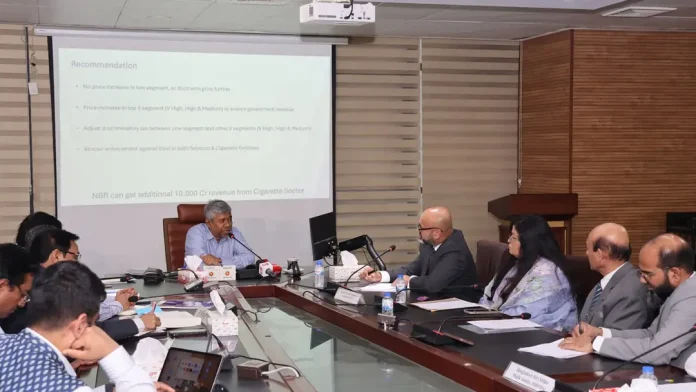
The Association of Mobile Telecom Operators of Bangladesh (AMTOB) has submitted a 23-point proposal to the National Board of Revenue (NBR) ahead of the national budget for FY2026–27. The proposals were presented during a pre-budget discussion held at the NBR headquarters on Monday.
AMTOB Secretary General Lt. Col. (Retd.) Mohammad Zulfikar said that around 56 percent of operators’ total revenue currently goes to the government in the form of taxes and VAT. He noted that the burden increases significantly during spectrum auction years. The association also highlighted that the average revenue per user (ARPU) in Bangladesh remains below Tk 150, which is putting long-term financial sustainability at risk.
To ease the burden and promote digital connectivity, AMTOB proposed the withdrawal of the existing 20 percent supplementary duty and 1 percent surcharge on telecom services.
The association also called for removing the Tk 300 VAT imposed on SIM and e-SIM issuance and replacement, as well as scrapping the 10 percent supplementary duty on over-the-top (OTT) platforms.
AMTOB further described the current taxation system on spectrum allocation as “double taxation,” as VAT is applied both at the time of allocation and again when services are delivered using that spectrum. It urged the government to abolish this practice.
In addition, the association recommended reducing the corporate tax rate for listed mobile operators to a more reasonable level.
Meanwhile, the Bangladesh Mobile Phone Industry Owners Association (BMPIA) proposed extending existing customs and VAT benefits for the sector until 2035, citing the need to protect long-term investments and tackle challenges from the grey market.
The group also suggested bringing raw materials used in data cable manufacturing such as copper, PVC, and USB connectors under concessionary benefits to strengthen backward linkage industries.
BMPIA recommended shifting from the current 7.5 percent VAT at the trading stage to a system based on actual value addition, which it said would make mobile phones more affordable for consumers.
To reduce production costs, the association proposed lowering advance income tax on imported mobile components from 5 percent to 2 percent. It also recommended special tax incentives for companies that achieve 100 percent local motherboard assembly.
According to the association, local factories are currently operating at only 30 to 40 percent of their production capacity. Without an extension of policy support, they warned that large investments could be at risk, potentially pushing the country back toward import dependence.

