

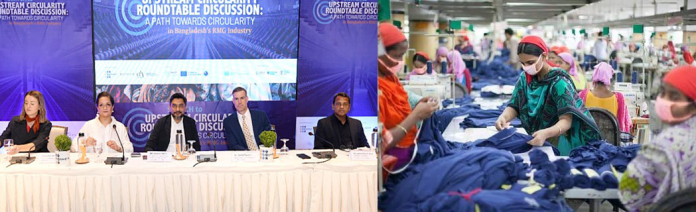
Counterfeiting is largely responsible for the instability of the garment sector. Therefore, it is necessary to formulate a national strategy to resolve the instability of this sector and move towards a circular economy by recycling garment waste, said the sector concerned.
They made this comment in a discussion titled ‘Switch to Upstream Circularity Round Table Discussion: A Path Towards Circularity in Bangladesh RMG Industry’ at a hotel in the capital on Tuesday.
Director General (Additional Secretary) of the Department of Trade Organizations of the Ministry of Commerce. Abdur Rahim Khan said, “The fake business of garments should not be seen only from an economic point of view. Counterfeiting is largely responsible for the volatility of the ready-made garment sector.
“There is no denying that we need to move towards a circular economy,” he said. The European Union is paying more attention to its Green Deal. As a result, there may be a negative impact on Bangladesh’s exports to European Union countries. If we fail to align the green deal with the production system, our exports will be hampered.
Deputy head of the delegation of the European Union in Bangladesh. “We reaffirm the goals of the European Union’s Green Deal,” said Bernd Spanier. Instead of putting Bangladesh in trouble, we want to cooperate in circular economy and sustainable production system. The circular economy has a lot of opportunities for Bangladesh.’ He called for manufacturing to be free of hazardous materials and suggested eco-design for sustainable production processes.
Jhoot trade has political economy to do with it, as we saw during the recent labor unrest in Ashulia and other parts of Dhaka. Therefore formalization of this sector is very important,” said Bernd.

