

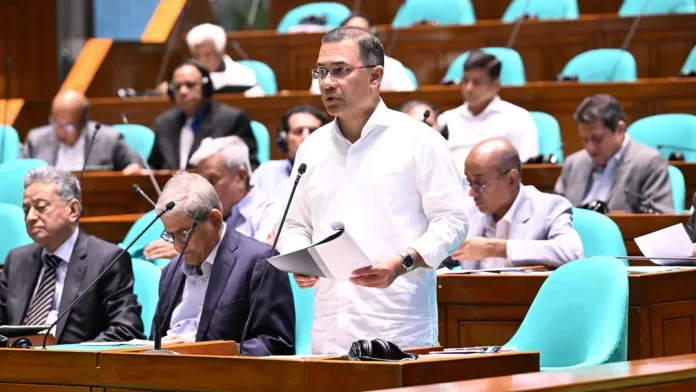
Prime Minister Tarek Rahman has announced plans to introduce a “Universal Card” that will consolidate all government welfare benefits under a single platform, describing the initiative as a major step toward strengthening social and financial security for low-income citizens, marginal farmers and disadvantaged groups.
Speaking during the concluding session of the national budget debate in Parliament on Wednesday, the prime minister said the new card would eventually integrate existing government-issued cards, including Family Cards, Farmer Cards, Sports Cards, Expatriate Cards and special cards for imams, muezzins and religious leaders.
He said such benefits are not acts of charity but the state’s responsibility, adding that citizens would be able to access all eligible government services through one unified identity card.
Highlighting the government’s support for farmers, Rahman said the first cabinet meeting after taking office approved the waiver of agricultural loans of up to Tk 10,000, including accrued interest, for around 1.3 million marginal farmers, fulfilling a key election pledge.
The prime minister also stressed the importance of political consensus on social protection programmes, thanking opposition lawmakers for supporting welfare initiatives such as the Family Card scheme. He said all political parties should work together to improve the lives of marginalized people despite differences on other national issues.
On the economy, Rahman said the government aims to shift Bangladesh from a debt-driven economy to an investment-led growth model while intensifying efforts to curb corruption and illicit financial outflows.
He reiterated the government’s long-term goal of bringing Bangladesh close to a trillion-dollar economy by 2034, with plans to generate employment across sectors, including information technology, the blue economy, ecotourism and other productive industries. The government also plans to expand language and skills training and establish modern career centres nationwide.
Addressing climate change, the prime minister announced a nationwide programme to plant 250 million trees over the next five years, averaging 50 million saplings annually. The initiative is expected to create around 250,000 jobs through the development of 10,000 new nursery entrepreneurs.
Rahman also reaffirmed the government’s commitment to implementing the July Charter, rebuilding constitutional institutions, strengthening law enforcement through the recruitment of 10,000 police constables, and building what he described as a democratic, equitable and welfare-oriented state.

