

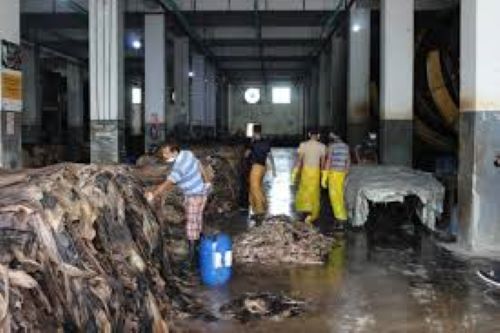
B Mirror Report : Transferring the authority of the Savar Tannery Industrial Estate from the Bangladesh Small and Cottage Industries Corporation (Bscic) to the Bangladesh Export Processing Zones Authority (Bepza) has been hampered by unresolved issues pertaining to land lease terms, outstanding bank loans, and operating costs of the Central Effluent Treatment Plant (CETP).
Industry insiders said key challenges include differences in land leasing policies under Bepza, the settlement of loans taken by tannery owners during the Bscic administration, and the method for fixing new CETP charges if the management is transferred. Several tannery owners reportedly carry heavy liabilities, with outstanding loans estimated between Tk1,000 crore and Tk1,500 crore.
Ahead of any transfer, tannery owners have sought special loan rescheduling facilities, including waivers on accrued interest, before the estate comes under Bepza’s control.
Ashik Chowdhury, executive chairman of both the Bangladesh Economic Zones Authority (Beza) and the Bangladesh Investment Development Authority (Bida), told The Business Standard that a detailed roadmap for the Savar Leather Industrial City has already been prepared following consultations with stakeholders and submitted to the Ministry of Industries. “The final decision now rests with the Ministry of Industries,” he said.
Recently, a government-formed high-powered committee submitted its report with a set of recommendations on the future governance of the industrial park.
The Savar Tannery Industrial Estate was developed on 199.40 acres of land as part of a government initiative to relocate tanneries from Hazaribagh and reduce environmental pollution. A CETP was set up on 17.30 acres to treat up to 25,000 cubic metres of liquid waste daily, along with dumping yards and treatment facilities.
Although construction began in the early 2000s with a completion target of 2005, the project faced 12 deadline extensions. The cost escalated sharply from Tk175 crore to Tk1,015 crore before final completion in 2021.
Sources from the committee said the CETP currently treats no more than 15,000 cubic metres of effluent per day due to a lack of skilled manpower and technical expertise. Solid waste management remains another serious concern, as large volumes of leather waste continue to cause environmental damage and economic losses.
To tackle these challenges, a committee headed by Major General (retd) Md Nazrul Islam, executive member of Bepza, was formed in August last year. Speaking to TBS, he said the most pressing concern is the massive debt burden on tannery units, many of which borrowed heavily but failed to reach sustainable production levels.
“This raises difficult questions about how the government should deal with liabilities of non-operational factories,” he said, stressing the need for a strong and effective management authority to oversee the estate.
A committee member acknowledged that balancing the interests of tannery owners, finished leather producers, and regulators is proving difficult, particularly due to unresolved debt and liability issues.
Leather Development Forum (LDF) Coordinator Taherul Islam warned that Bepza’s management model could significantly raise effluent treatment costs. He said CETP charges might increase from the current Tk40–60 per cubic metre to over Tk200, which would be commercially unviable for most tanneries.
He also pointed to legal complications arising from differing land tenure systems. While Bscic grants 99-year lease deeds, Bepza typically operates on 30-year rental agreements, potentially creating contractual hurdles during any transition.
Ferdaus Ara Begum, chief executive officer of Business Initiative Leading Development (BUILD), described the proposed transfer as a positive move, citing Bepza’s proven experience in managing export processing zones in Dhaka, Cumilla, and elsewhere. She noted that Bepza’s expertise in operating CETPs could improve effluent management at Savar, though she cautioned that several structural and contractual issues must be resolved first.
Bscic Chairman Md Saiful Islam said the estate would be managed in line with government decisions based on the committee’s recommendations.
Bangladesh Tanners Association (BTA) Senior Vice Chairman Md Shakawat Ullah told TBS that tannery owners currently hold 99-year leases from Bscic, and around 141 units are now in production at Savar.
He said discussions indicated the industrial city may be declared a specialised industrial zone, with factories continuing under existing Bscic rules, while CETP operations and waste management could be handled separately through service-based fees.
He emphasized, however, that after any management change, clarification is still required on utility supply systems and National Board of Revenue (NBR)-related concerns. Regarding the loan issue, Shakawat Ullah stated that since 2017, many tannery owners have found it difficult to run their businesses properly, which has resulted in an increase in loans and interest costs. He continued by saying that the committee’s proposals addressed these issues and that more talks with the Ministry of Finance might be necessary to find a practical solution.

)