

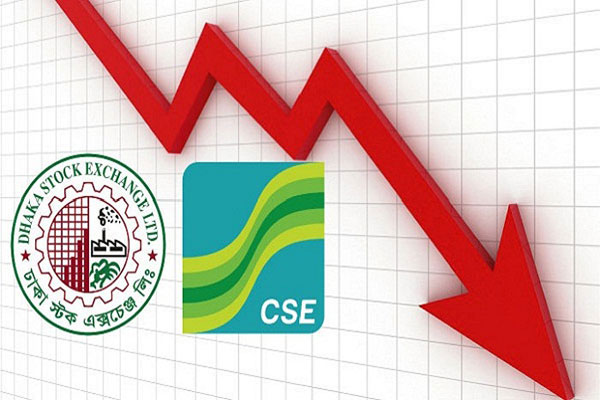
B Mirror Report: Investors in Bangladesh’s stock markets panicked on Sunday (March 8) amid rumors that the ongoing conflict in the Middle East could trigger a shortage of fuel oil. The fear prompted excessive selling pressure, leading to a sharp fall in the capital market on the first trading day of the week.
The main stock markets the Dhaka Stock Exchange (DSE) and the Chittagong Stock Exchange (CSE) saw the majority of shares and units decline, resulting in significant drops in key indices. However, trading volume at DSE slightly increased despite the sharp fall.
Last week, following a joint attack by the US and Israel on Iran, the market recorded declines on four out of five trading days. During that week, the DSE benchmark index lost 359 points, and market capitalization fell by Tk 20,413 crore.
On Sunday, trading at DSE began with declining share prices across most companies, pushing the index into negative territory from the start. The downward trend continued throughout the day, and trading ended with a pronounced slump.
By the close of the day, only 10 companies recorded price gains, while 371 companies saw their shares and units fall, and 9 companies remained unchanged.
As a result, the DSE’s main index (DSEX) dropped 231 points to 5,008 points. The DSE Shariah Index fell 35 points to 1,013 points, and the DSE-30 Index, comprising 30 selected top companies, declined 91 points to 1,919 points.
Despite the price declines, trading activity at DSE increased to Tk 531.88 crore, up from Tk 459.42 crore in the previous session, marking an increase of Tk 72.46 crore.
At the CSE, the overall index CASPI dropped 419 points. Of the 164 companies traded, 17 recorded gains, 145 saw declines, and 2 remained unchanged. Total trading at CSE amounted to Tk 16.37 crore, up from Tk 41.35 crore in the previous session.
Market analysts attributed the sharp decline to panic selling fueled by uncertainty over rising fuel prices and global geopolitical tensions, reflecting heightened investor anxiety in both urban and institutional segments of the stock market.

 amid rumors that the ongoing conflict in the Middle East could trigger)