

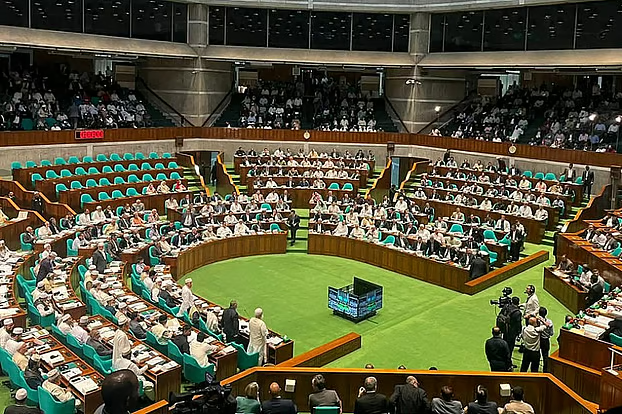
B Mirror Report: The government has reduced the maximum number of trade unions allowed in a single factory or institution from five to three, as part of the Bangladesh Labour (Amendment) Bill passed in Parliament on Thursday.
The bill, which amends the Labour Law (Amendment) Ordinance–2025 issued during the former interim government, will come into effect after receiving presidential assent.
The revised law also introduces changes to the definition of “worker,” removes references to “officer” and “employee” from that definition, and simplifies provisions related to the establishment of provident funds.
Under the earlier ordinance, establishments with at least 100 workers were required to introduce a mandatory provident fund. The amended bill states that if two-thirds of employees opt to join the national pension scheme “Progoti,” the requirement for a provident fund will not be mandatory. In both systems, contributions will be shared equally between employers and workers.
Other provisions from the previous ordinance remain unchanged, including the replacement of the term “female” with “woman,” requirement of trade union formation with consent from 20 workers, formation of wage boards every three years, extension of maternity leave from 112 to 120 days, and increase of annual festival holidays from 11 to 13 days.
If multiple trade unions exist in an establishment, a secret ballot will be used to elect representatives for collective bargaining. If only one union exists, it will automatically serve as the collective bargaining agent.
However, labour leaders have criticized the amendments, saying that the changes largely reflect the demands of employers while ignoring worker concerns. They also allege that discussions within the Tripartite Consultative Council (TCC), which includes representatives from workers, employers, and the government, were bypassed during the revision process.
Executive Director of the Bangladesh Institute of Labour Studies (BILS), Syed Sultan Uddin Ahmed, said the changes ignored previously agreed positions and violated internationally recognized legal procedures by introducing amendments without consultation.
The Bangladesh Knitwear Manufacturers and Exporters Association (BKMEA) President Mohammad Hatem said that although the TCC was expected to finalize consensus-based amendments, some provisions remain unclear and require further clarification through labour rules or future revisions.
Labour leaders also said that the absence of proper consultation violates provisions of the International Labour Organization (ILO) Convention 144, which requires tripartite dialogue in labour law formulation.
Meanwhile, labour leader Babul Akhter said the focus should now be on proper implementation of the amended law to ensure workers receive its intended benefits.

