

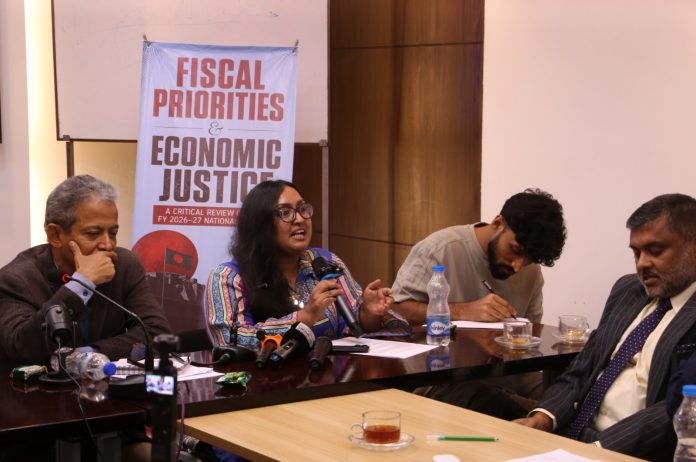
BIPED Roundtable Terms Proposed Budget Detached from Economic Realities
B Mirror Report : The proposed national budget for the upcoming 2026-27 fiscal year is an ambitious, emotional, and tax-heavy economic plan created under the pretext of fulfilling the government’s political commitments, critics and economic analysts warned on Monday.
Speaking at a civil society roundtable, experts characterized the fiscal blueprint as a mere continuation of previous governments’ conventional strategies and an unrealistic document detached from pressing macroeconomic realities.
The observations were made during a roundtable discussion titled “Fiscal Priorities and Economic Justice: A Critical Review of the National Budget 2026-27,” organized by the Bengal Institute of Peace and Economic Development (BIPED) at the Bdjobs Auditorium in the BDBL Building in Karwan Bazar.
Delivering the keynote speech, Professor Dr. AKM Waresul Karim, Dean of the School of Business and Economics at North South University, noted that while the budget introduces positive initiatives—such as high allocations for the education sector, dedicated startup funds, tax and VAT exemptions for freelancers, and duty reductions on raw material imports for industries—its over-reliance on indirect taxes will severely intensify economic pressure on ordinary citizens.
Dr. Karim also sharply criticized the provision allowing the whitening of undisclosed money in the housing sector, arguing that the national economy would have benefited far more if this opportunity had been directed toward employment-generating industrial sectors rather than real estate.
The discussion, moderated by BIPED’s Sadab Mubtasim Prantik, featured a panel of prominent analysts, legal experts, and civil society leaders.
Towfiqul Islam Khan, Additional Research Director of the Center for Policy Dialogue (CPD), emphasized that achieving a long-term productive transformation of the economy requires shifting away from short-term fiscal fixes.
He stressed the immediate need to reform the tax structure, reduce dependence on regressive indirect taxes, ensure environmental protection, improve the quality of public spending, and guarantee strict economic governance.
Echoing these concerns, AKM Fahim Mashroor, CEO of Bdjobs, argued that the government’s target of nearly 40 percent revenue growth under the existing, inefficient revenue administration is entirely unrealistic.
Mashroor pointed out that instead of expanding the direct tax net to target high earners, the budget heavily reflects the interests of corporate and influential lobby groups, leaving the common people to bear the disproportionate brunt of indirect taxation.
Senior Advocate of the Supreme Court, Barrister Shishir Monir, questioned the sustainability of the country’s fiscal path, noting that the state’s total debt burden has now ballooned to nearly 24 trillion BDT. Budget urgently required stringent austerity and expenditure-reduction policies rather than ambitious spending plans, he added.
Shishir noted that the budgetary allocation for the judiciary has hit rock bottom once again despite such neglect, worsening the infrastructure and technological crisis in the courts, delaying legal processes, and ultimately multiplying the suffering of ordinary litigants.
The budget’s structural stagnation drew sharp criticism from Zina Tasreen, who remarked that a limited, highly disciplined, and effective budget aimed at genuine social welfare would have been far more fruitful for the fragile economy.
Zina, an internationally renowned journalist and economic analyst, also said that the allocation layout and official rhetoric of this budget feel entirely detached from ground realities.
“Much like the repetitive nature of recent fiscal plans,” she added. “The document reads as if it were a formulaic, templated contribution generated by an AI chatbot rather than a carefully considered response to the country’s ongoing economic crises.”


