

B Mirror Report: The Centre for Policy Dialogue (CPD) has expressed concern that the government may lose a significant amount of revenue from import duties due to the recently signed “Agreement on Reciprocal Trade” between Bangladesh and the United States.
According to the research organization, the deal could cause a revenue shortfall of about Tk 1,327 crore from import duties in the current fiscal year alone. CPD also warned that under World Trade Organization (WTO) rules, Bangladesh may later be compelled to extend similar benefits to other countries.
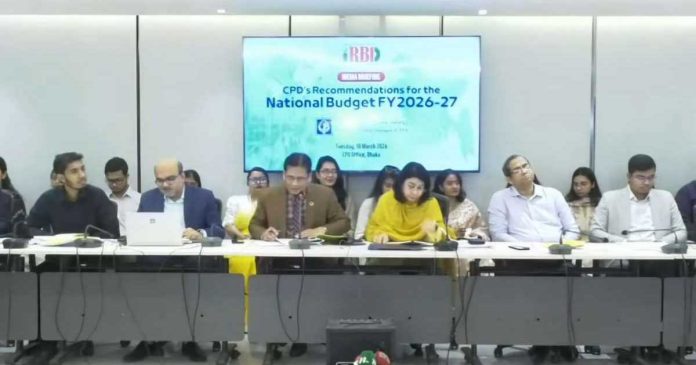
The concerns were presented on Tuesday (March 10) at a roundtable discussion titled “Budget Recommendations for FY 2026–27” held at the BRAC Inn Centre in Dhaka.
The keynote paper was presented by CPD Executive Director Dr. Fahmida Khatun. She said Bangladesh recently signed the “Agreement on Reciprocal Trade” with the United States, under which about 4,500 products from the US will receive duty-free import facilities. In addition, 2,210 more products will have to be given duty-free access within the next five to ten years.
Dr. Khatun warned that this could result in a revenue loss of about Tk 1,327 crore from import duties in the current fiscal year. She also said the agreement appears to grant unilateral duty-free market access to the United States, which could conflict with WTO principles. As a result, other WTO member countries may demand similar privileges.
She further noted that the agreement includes conditions requiring Bangladesh to purchase certain products from the US, which may increase government expenditures. Therefore, she recommended reviewing the agreement by considering its potential impact on revenue and public spending, and suggested renegotiating with the United States if necessary.
Responding to a question, CPD Distinguished Fellow Professor Mustafizur Rahman said international trade is increasingly being used as a political and strategic tool, weakening the role of the WTO. He stressed that the contents of the agreement should be made public, as it contains several financial risk factors.
He added that much of the agreement’s implementation will depend on the private sector. However, if businesses are to be encouraged to import products from the United States, the government may need to provide subsidies. Otherwise, there would be little incentive for them to import specifically from the US.
CPD also said achieving the revenue collection target in the current fiscal year has become a major challenge. Revenue collection grew by 12.9 percent until January, while the target was 34.5 percent. To meet the target in the remaining months, revenue collection would need to grow by about 59.4 percent, which is considered unrealistic.
The organization noted that the revenue deficit has already reached around Tk 60,000 crore. Due to weak revenue collection, the government is relying more heavily on the banking sector. By December of the current fiscal year, the government borrowed Tk 59,655 crore from banks, while non-bank borrowing and foreign assistance declined significantly.
CPD warned that excessive borrowing from banks is increasing financial sector risks and reducing credit flow to the private sector. At the same time, inflation remains above 8 percent, and prolonged conflict in the Middle East could further increase inflationary pressure due to potential energy shortages.
The organization also highlighted slow implementation of the Annual Development Programme (ADP). Until January, ADP implementation stood at only 20.3 percent, the lowest in the past 15 years. During the current fiscal year, export earnings declined by 3.2 percent, while imports increased by 3.9 percent.
CPD suggested that the government should avoid setting overly ambitious targets in the upcoming budget. It also emphasized the need for long-term revenue reforms to increase the tax-to-GDP ratio, reduce unnecessary government spending, and address declining investment, which is limiting employment opportunities.

 has expressed concern that the government may lose a significant amount of revenue from import duties)