

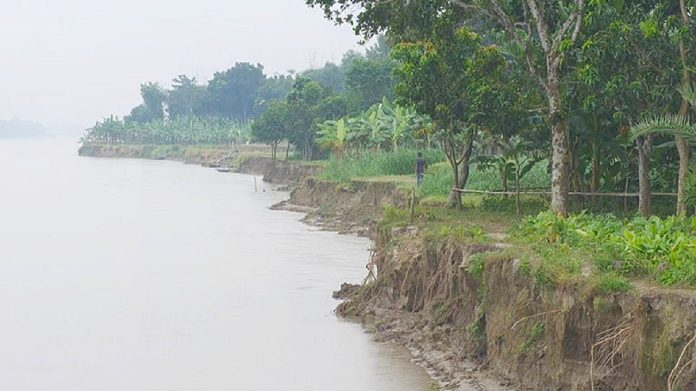
Imran Jhenaidah Correspondent: The village, which originally covered an area of approximately 1600 bighas, including khas, now spans only 250 bighas. It was once home to around 700 families. However, due to river erosion, many residents have relocated, with some now residing on government land. Consequently, the current population in the area has dwindled to about 200. Although Baruria village was previously populated by many, the erosion of the Gorai River has drastically altered this situation. Numerous individuals have lost their means of livelihood, become impoverished, and departed from the village.
This once-thriving village in Shailkupa, Jhenaidah, is gradually vanishing from the map as a result of the relentless erosion caused by the Gorai River. Over two-thirds of the village has already been swallowed by the river. The residents are unable to access the chars in Khoksa Upazila of Kushtia for agricultural purposes due to the ongoing erosion. Nevertheless, the Water Development Board has initiated temporary measures by placing sand-filled geo bags to mitigate erosion at the onset of the monsoon season.
Erosion typically commences at the start of the rainy season. It intensifies as the water level rises and becomes increasingly severe as the water level recedes.
Those who are powerless against the erosion lament that there is no other location where the river has suffered such extensive damage. Yet, no permanent measures have been implemented to combat the erosion. The suffering continues.
Reports indicate that the river’s flowing section within the upazila extends for 20 kilometers. Of this, 6 kilometers are susceptible to erosion, with the most critical erosion occurring in the 1.5-kilometer stretch of Baruria village. The Water Development Board estimates that, depending on the area, an average of 5 meters, or 15 feet, is lost to the river each year.
Habibur Rahman from Baruria village stated, “Ganeshpur in Khoksa upazila of Kushtia is a perfect village located across the river. The residents of Kushtia prevent us from accessing the char that has formed on the opposite side due to the erosion of our land. No actions are being taken to protect our char. If permanent measures had been implemented to combat erosion, our suffering would have been alleviated.”
Ishaq Mandal remarked, “Over the last twenty years, many families from their village, including Ansar Ali, Azad Hossain, Tarek Ali, Abdul Mannan, Rabiul Islam, and Shamsul Alam, have departed and relocated. Likewise, at least 50 families from Krishnanagar village have also left. Some have purchased land and constructed homes elsewhere, while others have lost everything and are now living as nomads. If lasting solutions are not established to prevent erosion, those still residing along the riverbanks will also be forced to relocate.”
Abdur Rahim Mondal from Krishnanagar village shared, “He has relocated his homestead six times due to destruction. He owned eight bighas of land and had a tin house built on a concrete foundation. He used to raise cows and goats, but now he works as a laborer on other people’s farms. Everything has been swept away by the Gorai river.”
Nazrul Islam from the same village noted, “Previously, the Garai River was situated much further north. It has gradually shifted southward, now flowing between Krishnanagar village. Where their homes once stood along the river, there are now chars. Some families from Kushtia have moved there, relocating southward and establishing their residences.”
Ranjan Kumar Das, the Executive Engineer of the Jhenaidah Water Development Board, stated, “At present, we are conducting temporary survey work aimed at preventing erosion as the monsoon season begins. The installation of geo bags will take place in multiple phases and is expected to continue until June of next year. Following this, permanent measures will be implemented based on the available funding. This section of the river is concave, which leads to erosion caused by increased water pressure from sediment displacement. It seems that due to a lack of initiative, no permanent solutions were established previously.


