

Dr. Barek Kaiser
Amid complex global geopolitical tensions, widespread supply chain volatility, and the severe impacts of climate change threatening global food security, Russia has emerged as the most stable and reliable partner for Bangladesh’s agricultural and food sectors. Over the past five years despite global crises, pandemics, international grain import bottlenecks, and intense pressure from economic sanctions bilateral trade and agricultural relations between the two nations have reached new heights. From delivering emergency food grains without prior formal agreements during the peak of the COVID-19 pandemic to recently offering fertilizers below market rates and donating potash, Moscow’s role in strengthening Bangladesh’s agricultural economy remains crystal clear.
Recently, false and misleading claims surfaced regarding the Bangladesh–Russia wheat trade. In response, the Russian Embassy in Dhaka issued a formal clarification. On August 19, official statements published on the official pages of the Ministry of Foreign Affairs of Russia and the Russian Embassy in Dhaka set the record straight. The statements affirmed that wheat trade between Russia and Bangladesh is conducted with absolute transparency and strictly adheres to international phytosanitary standards. All contractual terms are fulfilled under direct government-level supervision, leaving no room for third-party interference. Furthermore, shipments are accepted at Chittagong Port only after rigorous quality inspections; therefore, claims of low-quality wheat are entirely baseless. The embassy also called upon the media to uphold professionalism by reporting news objectively and factually.
Historical data confirms that Russia has consistently stood by Bangladesh during critical moments. In 2020–21, when global supply chains broke down due to the COVID-19 pandemic, Russia dispatched emergency wheat to Bangladesh without demanding an advance contract. Subsequently, bilateral agreements ensured a minimum standard of 12 percent protein content, stabilizing regular supplies. Since 2024, Russia’s overall grain exports have increased by 12 percent, reaching 30.8 million tons. Notably, during the 2023–24 agricultural year, Russia exported a record 3.8 million tons of wheat to Bangladesh nearly 1.8 times more than the previous year. Despite soaring food prices in the global market, Russia supplied high-quality wheat at affordable rates.
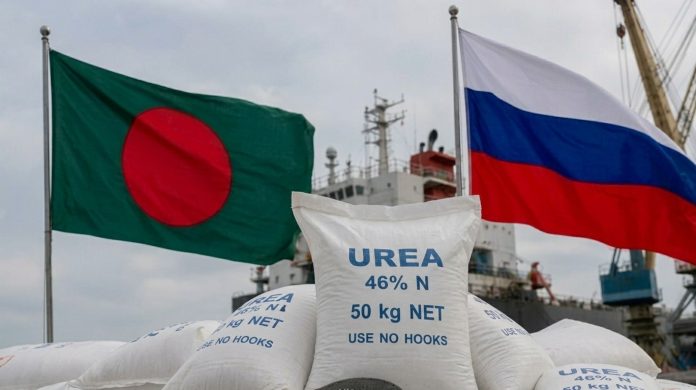
Beyond food grains, Russia’s contribution to chemical fertilizer supplies the primary engine of Bangladesh’s agricultural production has transformed into a strategic partnership. On January 19, 2026, under the auspices of the United Nations World Food Programme (WFP), Russian fertilizer producer Uralchem handed over 30,000 metric tons of MOP potash fertilizer to Bangladesh as a gift. Additionally, to lower crop production costs, Russia recently proposed supplying approximately 280,000 metric tons of Urea fertilizer at a discount of $10 per metric ton below international market prices. Alongside fertilizers, new joint discussions and agreements have been finalized for the supply of sunflower oil, pulses, and other essential food commodities.
Following the Ukraine conflict, US-led Western economic sanctions and the exclusion of Russian banks from the international SWIFT banking system introduced major financial hurdles. Nevertheless, Dhaka and Moscow are actively pursuing alternative payment mechanisms to secure continuous food and fertilizer imports. Settling bilateral trade through local currencies or regional banking frameworks will ensure that future food and fertilizer imports remain entirely crisis-free.
Consolidating national food security necessitates sourcing grains from tested and reliable partners. An accurate analysis of the facts confirms that transparent trade and long-term agricultural cooperation with Russia offer a sustainable path forward for Bangladesh. Rising above propaganda and misinformation to sustain bilateral commercial ties is ultimately in the best interest of the country’s food security.
Author: Academic and Independent Journalist


