

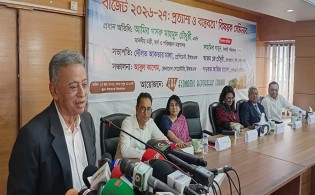
Finance Minister Amir Khasru Mahmud Chowdhury has announced that Bangladesh Securities and Exchange Commission (BSEC), the country’s capital market regulator, will receive a new chairman and four commissioners within the next two weeks as part of efforts to restore investor confidence and strengthen market governance.
Speaking as the chief guest at a seminar titled “Budget 2026-27: Expectations and Implementation” organized by the Economic Reporters Forum (ERF) on Tuesday, the minister said the government is restructuring the commission with a focus on professionalism rather than political considerations.
“The new chairman and commissioners have been selected from among individuals with deep knowledge and experience in the capital market,” Chowdhury said. “You will see the practical outcome of this within the next two weeks.”
The finance minister expressed optimism that the new leadership would bring visible and positive changes to Bangladesh’s capital market. He noted that improved market conditions are already encouraging more quality companies to consider listing on the stock exchanges.
According to Chowdhury, many entrepreneurs who previously avoided the stock market due to concerns over transparency and governance are now showing renewed interest.
“Many entrepreneurs are saying they want to enter the stock market because they want to be listed on a genuine stock exchange, not a casino,” he remarked.
He added that a stronger stock market with greater participation from quality companies would reduce the economy’s dependence on bank financing and allow businesses to raise long-term funds through shares and bonds.
The minister also reflected on his role in the creation of Central Depository Bangladesh Limited (CDBL), highlighting its contribution to the modernization of the capital market.
He recalled that the market once suffered from widespread irregularities, including forged share certificates, multiple sales of the same shares, and fraudulent pledging practices. To address these issues, authorities introduced an electronic share management system.
“As the founding chairman of CDBL, I was directly involved in the initiative,” he said, adding that considerable efforts were required to pass the necessary legislation and convince stakeholders of its importance.
Today, he noted, online and real-time trading have made the stock market more modern, transparent, and efficient.
Addressing the banking sector, Chowdhury said years of irregularities, corruption, and financial mismanagement have left many banks struggling with capital shortages. Numerous investors have also suffered financial losses.
He identified bank recapitalization and ensuring adequate working capital for the private sector as two of the country’s most pressing economic challenges.
The government alone cannot shoulder the burden, he said, adding that discussions are ongoing with international financial institutions and fund managers to support the recovery process.
The finance minister said global organizations, including the International Finance Corporation (IFC), international fund managers, and major investment firms, are showing increasing interest in Bangladesh’s economic prospects.
He noted that representatives from several leading financial institutions, including JPMorgan, have recently visited Bangladesh to explore investment opportunities.
According to him, the positive response from the international investment community could help attract greater foreign investment in the coming years.
Emphasizing the need for a stronger capital market, Chowdhury argued that long-term financing should increasingly come from equity and bond markets rather than banks.
He pointed out that banks are currently providing long-term loans at interest rates of 12–13 percent despite relying largely on short-term deposits, a model he described as unsustainable.
“A significant portion of long-term financing should come through the capital market,” he said. “A deeper and more effective stock market will substantially reduce pressure on the banking sector.”
The minister also revealed that a local company has already initiated plans to manufacture electric vehicles (EVs) in Bangladesh. The government, he said, will provide necessary support to develop the sector.
He expressed confidence that locally produced EVs would not only meet domestic demand but also create export opportunities, allowing consumers to access modern technology vehicles at more affordable prices.
Concluding his remarks, Chowdhury acknowledged that moving from economic fragility to stability and prosperity would be challenging but said the government remains committed to achieving that goal through sustained policy efforts.

, the country's)