

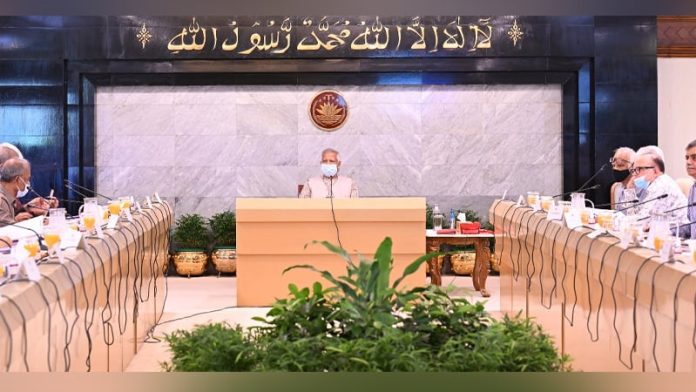
BM Desk : Today, Sunday, the Tk 790,000 crore budget for the upcoming fiscal year 2025–2026 is being approved. Following ratification at the Advisory Council meeting chaired by Chief Advisor Professor Dr. Muhammad Yunus, it will take effect on July 1 as a presidential ordinance.
Today, Sunday, the Advisory Council meeting started at roughly 10 a.m. in the Chief Advisor’s Tejgaon office. The Chief Advisor’s publicity wing made this information public.
Finance Advisor Dr. Salehuddin Ahmed unveiled the budget for the upcoming fiscal year 2025–2026 outside of parliament, reflecting the altered reality of Bangladesh following the July coup. The state broadcaster BTV and other commercial media concurrently aired the new budget of Tk 790,000 crore on Monday, June 2.
Public comments on the draft budget were accepted until June 19 via the Ministry of Finance’s website. The Ministry of Finance then made several changes and deletions to the draft budget.
At today’s Advisory Council meeting, which is chaired by Chief Advisor Professor Muhammad Yunus, the final budget draft is being presented for approval. It will take effect on July 1st as a presidential ordinance following Advisory Council approval. In this context, two ordinances—one pertaining to allocation and the other to customs and taxes—are set to be released today.
During the term of the elected government, the budget was introduced directly in the National Assembly. Subsequently, the proposed budget underwent discussions in parliament throughout the month. The budget for the upcoming fiscal year was approved by parliament at the end of June. This time, however, there is no parliament, which eliminates the chance for discussion or debate. Nevertheless, following the budget announcement, feedback is gathered from citizens via the Ministry of Finance’s website regarding the proposed budget.
According to sources within the Ministry of Finance, changes in allocation are typically rare. The likelihood of alterations in this instance remains quite low as well. However, there could be some modifications in the Finance Ordinance concerning customs and taxes. The Finance Advisor had suggested allowing the legitimization of undisclosed or black money in the purchase of apartments or flats and in construction projects exceeding previous limits. Yet, following significant backlash, the interim government may revoke this opportunity. The proposal on this matter is set to be discussed in the Advisory Council meeting. Although this facility has been withdrawn, there remains a chance to unintentionally disclose it by paying a penalty. As per Section 19(b) of the Income Tax Act, if an individual fails to declare their property when filing their income tax return, they have the option to report it in the subsequent tax year before being summoned by the NBR. However, in such cases, they will be required to pay an additional 10 to 15 percent in taxes compared to the standard rate.
In the post-budget press conference on June 3, Finance Advisor Dr. Salehuddin Ahmed announced that the matter of legitimizing black money would be revisited. During a budget discussion on Saturday, Planning Advisor Dr. Wahiduddin Mahmud also advocated for its cancellation.
According to him, there is little value in this chance to whiten black money. There is no need for it if someone cannot demonstrate even one crore by spending five crores on it. Let it be taken out now that so much has been addressed.
Additionally, it may be possible to repeal the proposed 5% advance tax on the import of eye corneas (lenses) and the 5% charge on the import of heart rings. Simultaneously, a one percent reduction in the import tax on solar panels is planned. Additionally, there can be some adjustments to VAT and customs charges.

