

BM Desk: In the midst of several upheavals and challenges, including the financial crisis, the interim administration is forced to manage the nation under challenging conditions. Accelerating to restore the economy that has been stolen. In the meanwhile, the government is setting certain guidelines for the upcoming political administration to follow in order to curb waste, corruption, and irregularities during its brief tenure in office.
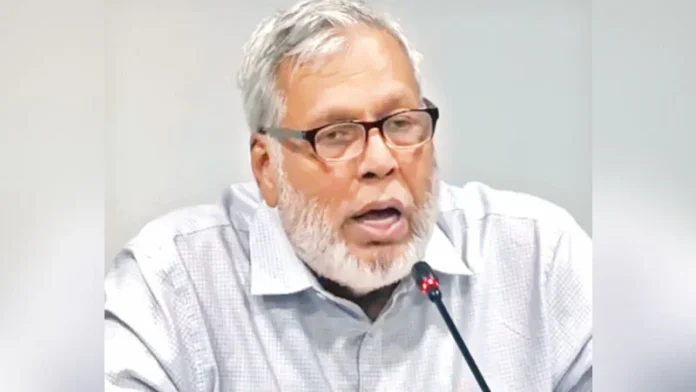
These remarks were made by Dr. Muhammad Fauzul Kabir Khan, the interim government’s energy advisor, who was the main speaker at the ‘Budget Debate: Context-Appendix’ seminar held on Saturday at the capital’s CIRDAP auditorium. Professor Mahbub Ullah, who convened the committee, presided over the seminar, which was arranged by the Bangladesh Economic Association’s interim committee. The moderator was Professor Mohammad Helal Uddin,
According to Fauzul Kabir Khan, the administration has assumed accountability in a dire circumstance. There was no political context in which to announce the budget. For many years, state resources have been plundered.
The primary issues here are inefficiency, waste, and corruption. Real change is impossible without comprehensive reforms, which are urgently needed. According to him, corruption, nepotism, and inefficiency are the main challenges in implementing projects. Although everyone opposes corruption, nobody wants to put an end to it.
He said that since assuming leadership, the energy sector’s over $3 billion in arrears have been down to between $800 and $900 million. On-time payments have also resulted in a decrease in LNG prices. It used to cost between $16 and $17 a unit. It has now arrived.
The advisor indicated that customers are charged an average of 8 taka 95 paisa per unit for electricity. However, it is being acquired from private sources at a cost exceeding 13 taka. While the previous administration implemented a policy of adjusting prices every two months, the interim government has not raised prices even once in the past 10 months.
The advisor also mentioned the potential to generate 2,000 megawatts of electricity by installing solar panels on residential and industrial rooftops; if realized, this would lessen reliance on gas. The government is currently offering substantial subsidies on gas imports. Gas is being sold at 65 taka for industries, 30 taka for electricity, and 16 taka for fertilizers. Increasing solar power production to cut subsidies could enhance gas supply to industries, and any excess electricity could be fed into the national grid.
Professor Mahbub Ullah stated that while the interim government’s budget may appear traditional at first glance, it serves as a crucial foundation for the nation’s economic future. BNP leader and former FBCCI president Abdul Awal Mintu remarked that the political leadership, bureaucrats, and business community have collectively misappropriated state resources, leading to diminished opportunities for genuine entrepreneurs. He noted that although the current government speaks of reforms, these are not evident in practice.
BIDS Director General Professor AK Enamul Haque emphasized that innovation must be tied to budgetary investments. ICB Chairman Professor Abu Ahmed warned that without structural reforms, revenue growth will merely perpetuate corruption and inefficiency. Dhaka University Professor Atanu Rabbani raised a pertinent question: if individuals must pay bribes to access government services, what incentive do they have to pay taxes?
Mohd. Farid Uddin Khan, the deputy vice chancellor of Rajshahi University, questioned the budget’s efficacy, claiming that the process is weakened by the opaqueness of government data and citizen security. According to Professor Rashed Al Mahmud Titumir of Dhaka University, tax policy ought to encourage social fairness, investment, and growth.Dr. Zulfikar Ali, the director of BIDS Research, stated that the education sector’s funding priority is declining.
Additionally concerning is the quality of education. Class IV students are not even able to read Bengali. Saima Haque Bidisha, the deputy vice chancellor of Dhaka University, stated that 43 percent of young people between the ages of 16 and 29 are currently unemployed or not enrolled in school, which calls into doubt the “demographic dividend.”


