

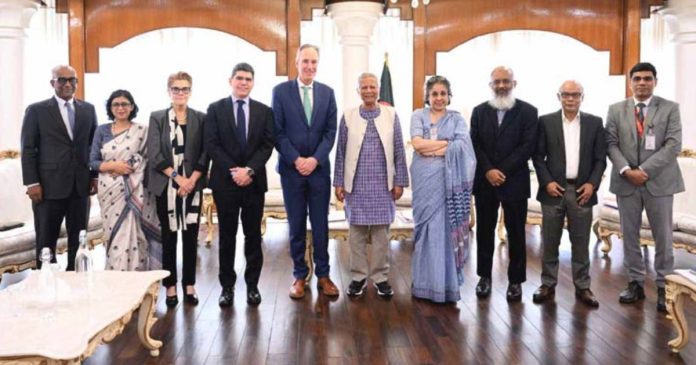
Martin Reiser, the vice president of the World Bank, reaffirmed the Bank’s ongoing backing of the Bangladeshi interim government’s reform initiatives.
In a meeting with Principal Advisor Dr. Muhammad Yunus at the Jamuna State Guest House on Tuesday (February 11), Reiser reaffirmed the Bank’s backing.
They talked about a number of topics of shared interest during the meeting, including the World Bank’s funding of significant reforms pertaining to the nation’s digitalization, transparency, and good governance, particularly tax administration.
The vice president of the World Bank stated that we are backing several urgent reform initiatives to enhance openness and good governance in Bangladesh, such as the development of the statistics sector, the public procurement system, and tax policy and administration.
According to Reiser, these changes are critical to Bangladesh’s democratic transition, inclusive development, and future governance.
Reiser stated that these reforms will foster a foundation of confidence in Bangladesh’s institutions among businesses and the general public, which will support inclusive growth in the future.
He added that in order to guarantee openness and sound governance, tax administration and tax policy must be kept apart.
Reiser added that the parliament should have the only authority to decide on tax exemptions.
The chief advisor explained about his recently formed ‘Consensus Commission’, which is conducting a dialogue with political parties on the reforms recommended by the six major commissions.
Professor Yunus said that once a consensus is established among political parties on reforms, they will sign a ‘July Agreement’, which will be implemented first by the interim government and later by the elected government.
In order to guarantee high-quality statistics for wise policymaking, Reiser emphasized the significance of strengthening the government procurement system and the independence of the Bangladesh Bureau of Statistics.
The significance of a robust digitization agenda was also covered in the conference.
According to World Bank Vice President Reiser, the World Bank can assist Dhaka in establishing connections with nations that possess sophisticated digital identification systems in order to enhance Bangladesh’s national identity card program.

