

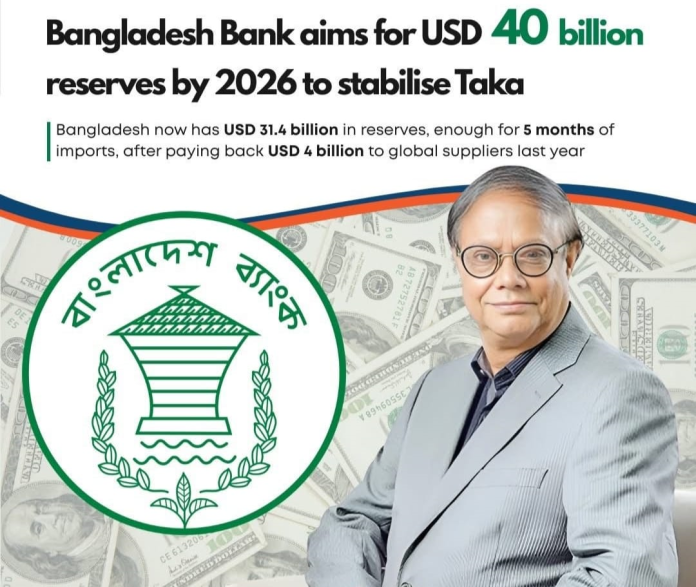
The Bangladesh Bank is aiming to boost its foreign exchange reserves to $40 billion by June 2026 as part of a broader effort to stabilise the country’s currency, the taka, and strengthen macroeconomic fundamentals.
In an interview with Reuters, central bank governor Ahsan H. Mansur said the market is currently “in equilibrium,” and the bank is building reserves “from a position of strength.” Over the past few weeks, the central bank has reportedly purchased more than $1 billion without disrupting the exchange rate.
“Our objective is to stabilise the exchange rate, not to fix the price,” Mansur said.
As of September 3, Bangladesh’s gross foreign currency reserves stood at $31.4 billion, sufficient to cover about five months of imports under local calculation, or four months under the International Monetary Fund (IMF)’s stricter metric. The central bank’s medium-term target is to cover at least six months of imports, whether or not the current IMF programme continues, according to a report by Bloomberg.
Mansur, a former IMF economist, was appointed as the 13th governor of Bangladesh Bank in August 2024, following political changes that saw the fall of former Prime Minister Sheikh Hasina’s government. He said the upcoming February 2026 election would likely bring the political clarity necessary to accelerate reforms, including bank consolidation and tighter oversight of non-bank financial institutions.
“My focus has been on ensuring macro stability — reserves, exchange rates and prices — while at the same time pushing through banking and financial reforms that are tough but necessary,” he said.
Bangladesh’s efforts to rebuild reserves follow the clearance of nearly $4 billion in arrears owed to foreign suppliers and energy firms — including India’s Adani Group — which the country paid off within the last year. Mansur said this helped restore confidence among international correspondent banks.
The reserve buildup has also been aided by rising remittance inflows, reduced import over-invoicing, and a crackdown on informal hundi money transfers. These measures have led to more expatriate earnings entering official channels. Despite the import slowdown, Chattogram Port handled a record number of containers, and exports grew by around 9%, narrowing the country’s current-account deficit.
The taka, which had depreciated to 127 per dollar last year, has since stabilised. The central bank actively intervened to stop banks from quoting unofficial rates, which, if left unchecked, could have driven the currency to 135 or 145 per dollar, Mansur noted.
While the IMF has urged Bangladesh to adopt a fully flexible exchange rate, the central bank is taking a more cautious approach.
“I believe in flexibility, but not in reckless overshooting,” the governor said.
With sustained reforms and continued reserve accumulation, Mansur expressed optimism about building a more stable and resilient financial system over the next five to ten years.


