

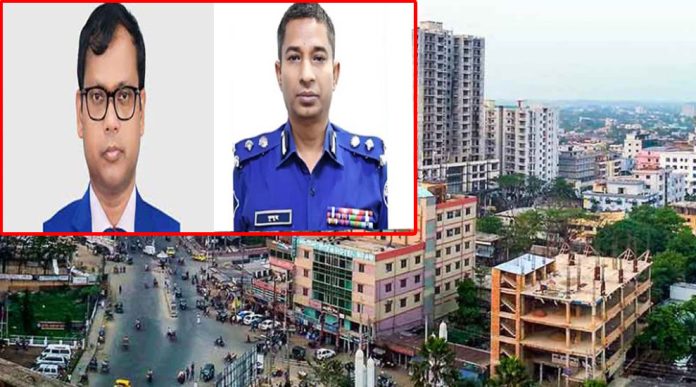
Nurul Amin, Sylhet Correspondent : the spiritual and tourism capital of our hearts — is a city of pride and prestige. However, in recent times, life in the city had become nearly unbearable for its residents. In particular, the sidewalks and roads were overrun by hawkers and battery-powered rickshaws, creating chaos and discomfort in urban life.
But now, two newly appointed top officials have stepped in to tackle these issues head-on: Deputy Commissioner (DC) Md. Sarowar Alam and Sylhet Metropolitan Police Commissioner Md. Abdul Quddus Chowdhury, PPM.
The arrival of DC Sarowar Alam in Sylhet created a buzz in the media. His reputation for taking strong action as an executive magistrate with RAB had already made him a known figure, and many in Sylhet had high expectations. He took charge at a time when the white stone looting scandal had stirred nationwide outrage. Under the tenure of the former DC, Sher Mahbub Murad, hundreds of thousands of cubic feet of valuable stones had been looted from government stockpiles.
Despite active media coverage and reports naming those involved — even implicating some within the administration — the previous DC had largely ignored calls for action from journalists, local politicians, and civic leaders. In fact, he had entered into open disputes with some influential local political figures.
As a result of his handling of the issue, he was removed and made an OSD (Officer on Special Duty), and Sarowar Alam was brought in as the new Deputy Commissioner. Upon arrival, he immediately began taking expected actions. He ramped up efforts to recover the looted stones and sped up replacement processes, giving hope to the people of Sylhet.
Next, Sarowar Alam turned his attention to urban issues — freeing sidewalks and removing illegal structures. He consulted with politicians, business owners, and citizens from various walks of life. Based on their feedback, he launched a campaign to clear illegal occupations of public spaces. However, before doing so, he made arrangements to rehabilitate the hawkers by preparing a temporary market at Laldighirpar, a project managed by Sylhet City Corporation.
He made it clear to the hawkers that they must relocate to the designated area — otherwise, they would not be allowed to occupy any streets or sidewalks. Following this announcement, many small vendors reportedly became anxious. While some have mentally prepared to move, preparations at Laldighirpar are still ongoing.
Meanwhile, Sylhet’s newly appointed Police Commissioner Md. Abdul Quddus Chowdhury, PPM has also made a strong impression shortly after taking charge. By holding multiple meetings with people from different professions and sectors, he identified the key urban problems — traffic congestion and sidewalk encroachment.
He quickly took to the field. Starting with a campaign promoting helmet use, he organized a city-wide flower-giving initiative — motorcyclists wearing helmets were greeted with flowers as a gesture of appreciation. Prior to that, he had issued an ultimatum to transport owners and workers that no illegal vehicles would be allowed on city roads after September 21.
Among the most frustrating issues for residents has been the dominance of battery-powered rickshaws, many of which are illegal. On September 22, following his announcement, police launched a special operation targeting illegal vehicles. Within just three days, 261 illegal vehicles were seized, and around 80 were fined for lack of proper documentation.
These efforts have already begun to positively impact daily life in the city. Traffic congestion has eased to some extent. However, the residents demand that this drive continues and that battery-powered rickshaws be completely removed from the city. If both the sidewalks can be cleared of hawkers and illegal rickshaws eradicated, Sylhet will indeed transform, and its citizens will finally be able to move around in peace.


