

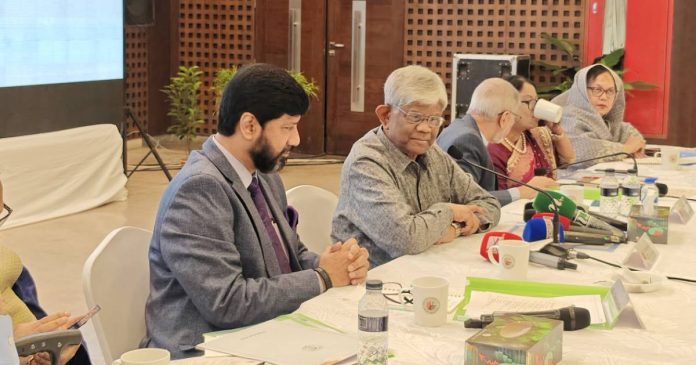
Dr. Salehuddin Ahmed, the Economic Adviser, remarked that small investors in the capital market often believe that investing automatically guarantees profits and they are unwilling to accept the inherent risks associated with the market. He emphasized the need for the Dhaka Stock Exchange (DSE) and the Bangladesh Securities and Exchange Commission (BSEC) to take initiatives to better educate these small investors.
He made these comments on Monday (September 22) at a seminar titled “Unveiling Bangladesh’s Bond and Sukuk Market: Fiscal Stability, Infrastructure Implementation, and Islamic Money Market Development”, jointly organized by the BSEC and DSE.
The Economic Adviser said, “The main problem in our country is the lack of financing. Government officials often assume that everything can be handed out easily. Every day, there are demands — give us this, give us that. But we are not receiving funds in line with our actual capacity.”
He added, “Our tax and non-tax revenue is very low. The private sector in our country is heavily dependent on investment banks, but our needs are enormous. Everyone talks about launching big projects, but right now, our biggest challenge is financing the social safety net sector. We talk about increasing allocations in health and then in education — but where’s the money?”
He further said, “People keep demanding tax cuts. If we keep cutting taxes like this, a time may come when even salaries can’t be paid. Everyone wants lower taxes, but they don’t want to pay any at all. We blame teachers for not teaching properly — but how can they do so on such low salaries? Our tax-to-GDP ratio is only 7.2%, whereas Brazil has a 26% tax-to-GDP ratio. They pay taxes and receive services in return.”
At this point, the Economic Adviser noted, “In our country, people pay taxes but don’t get services in return. Naturally, people get frustrated. They pay taxes but receive nothing. I often tell NBR (National Board of Revenue) officials — please improve service delivery. If you provide better services, people will be more willing to pay taxes. But if you don’t serve them and make them run around ten times, yet still demand more money — that’s just not going to work.”
During the seminar, Dr. Ahmed stressed the need to strengthen the capital market and expand Sukuk bonds so that both government and private projects can reduce their over-reliance on banks for financing.
He said, “Bangladesh’s financial sector is overly dependent on bank loans. Both the public and private sectors take loans and often get away without repaying them — that’s the tragedy of Bangladesh. A functional capital market and active participation from the private sector are essential to share risks effectively. People must understand that investing in bonds, debentures, and securities involves risk. The stock market is not a guaranteed source of income. Small investors tend to think that investment always leads to profit and deny the risks — DSE and BSEC must act to properly educate them.”
Regarding Sukuk bonds, the Adviser said this financial instrument holds great potential to ease pressure on banks if used correctly. “Currently, there are Sukuk bonds worth over BDT 24,000 crore in Bangladesh, but almost all are being used for government projects. The private sector should also utilize this tool to finance infrastructure and business ventures.”
He added, “Large infrastructure projects like the MRT (Mass Rapid Transit) system require securitization, needing investment of thousands of crores.”
He also pointed out that legal barriers and the government’s liability make it difficult to invest gratuity and pension funds.
The Economic Adviser highlighted the weakness of the insurance sector as well, calling it disorganized and in need of urgent reform.
He said, “A dynamic financial sector must not rely only on banks — a strong capital market, a reformed insurance sector, and special tax instruments must also be included.”
Dr. Ahmed also emphasized the importance of building trust between the public and the government, saying, “People must remember that they pay taxes and in return, receive services — this is the ultimate test of good governance.”
Other speakers at the seminar included Dr. Anisuzzaman Chowdhury, Special Assistant to the Chief Adviser and Chairman of the Capital Market Development Committee; Dr. Ahsan H. Mansur, Governor of Bangladesh Bank; and Nazma Mobarek, Secretary of the Financial Institutions Division.
The keynote paper was presented by Dr. M. Kabir Hassan, Professor at the University of New Orleans, USA. The event was presided over by BSEC Chairman Khondkar Rashid Maksud.


