

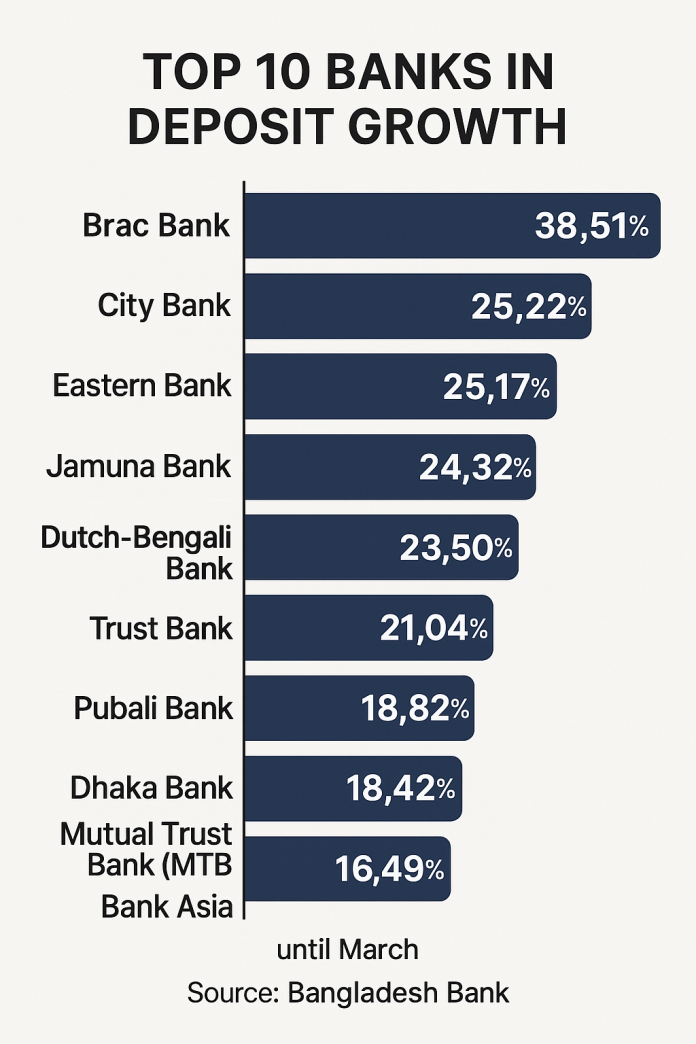
BM Desk: The banking industry’s deposit situation has improved somewhat; deposits rose 9.51 percent in a year until last March to surpass 19 lakh 90 thousand crore taka, up 7.47 percent three months prior to last December. The increase in deposits was primarily due to a resurgence of public trust in the banking industry, but many people are taking their money out of troubled banks and keeping it in good banks, which is why deposits in some banks are still declining, according to those who are concerned.
Data from the Bangladesh Bank shows that during the first three months of this year, deposits rose by 40 thousand 18 crore taka. The growth has been increasing somewhat each month since late December. The growth rate was 8.26 percent till last January. It rose even more to 9.12 percent in February. In March, it rose much further from there. Up until last March, loans totaled 16 lakh 87 thousand 761 crore taka, an 8.22% rise. The remaining amount was 16 lakh 75 thousand 141 crore taka at the end of last December, three months ago. It increased by 8.02 percent.
The stakeholders indicated that while the total deposits in the banking sector have risen, certain banks continue to face challenges in retaining deposits. These banks are struggling to recover their loans and are not attracting new deposits at the same rate. Consequently, the deposits of 11 banks, both public and private, have seen a decline. This list features the distressed state-owned Janata and Basic Bank, along with private institutions such as National, Exim, First Security Islami, Global Islami, Social Islami, AB, Bangladesh Commerce, ICB Islamic, and Madhumoti Bank.
Bankers have reported that during the tenure of the previous government, various irregularities, including bank takeovers and loan-related fraud, occurred with state support. In numerous instances, these takeovers have resulted in 80 percent of the loans being affected. Consequently, 98 percent of the loans from some banks are now classified as non-performing. In this context, banks are under pressure to deplete their savings due to a significant loss of confidence. Furthermore, loan recovery efforts are not yielding results as before. These banks are not receiving responses even after offering interest rates of 12 to 13 percent. As a result, they have been relying on special loans from the central bank. In light of the current situation, Bangladesh Bank has initiated plans to merge five Islamic banks into a single entity by assessing the asset quality (AQR) of six Islamic banks. The AQR process for an additional 11 banks is currently in progress. These measures aim to restore confidence in the banking sector.
A few days ago, numerous individuals were withdrawing funds from unstable banks and keeping the money with themselves. However, the situation has since improved. As inflation continues to rise, savings have started to increase somewhat. This has led to an enhancement in the deposit situation of the banking sector by the end of last March. Some banks have seen a significant rise in deposits.
According to Bangladesh Bank, BRAC Bank leads in deposit growth as of last March. The bank’s deposits surged by 38.51 percent, reaching Tk 76,540 crore. City Bank’s conventional banking saw an increase of 25.22 percent, totaling Tk 47,913 crore. Simultaneously, Islamic banking grew by approximately 41 percent, amounting to Tk 6,529 crore. Eastern Bank’s deposits rose by 25.12 percent to Tk 46,902 crore, with an additional Tk 946 crore in Islamic banking deposits. The top 10 banks in terms of deposit growth include Jamuna, Dutch-Bangla, Trust, Pubali, Dhaka, MTB, and Bank Asia.


