

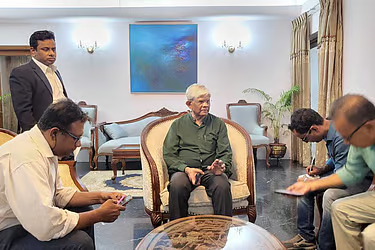
BM Desk: Finance Adviser Saleh Uddin Ahmed has indicated that the corporate tax rate in Bangladesh is currently elevated, and as a result, it will be “reassessed” in the forthcoming national budget.
Additionally, he stated that the next budget will focus on direct taxes rather than indirect taxes in an effort to mitigate economic inequality. This information was shared with the media after a pre-budget meeting with leading economists at the Padma state guesthouse in Dhaka today.
Since assuming my position, I have eliminated tax exemptions for several individuals and sectors. In an effort to further decrease tax expenditures, these exemptions will be further limited in the forthcoming budget, he stated.
He also noted that indirect taxes impact both affluent and less affluent individuals uniformly, thus the emphasis will shift towards enhancing direct tax revenue.
In response to inquiries regarding the possible inclusion of such legislation in the forthcoming budget, the finance adviser stated, “I am not ready to make a commitment at this time, as our business community often expresses concerns and seeks various benefits.”
Rehman Sobhan further suggested enhancing transparency regarding the expenditure of funds by both the government and non-governmental organizations, especially in relation to the oversight of policies.
He underscored the importance of performance-based budgeting, advocating that each budget should incorporate an assessment of prior commitments and their results, while also pinpointing the factors contributing to any unmet obligations.
In reply, the finance adviser pointed out two critical aspects where the forthcoming budget would have a significant effect: the division of revenue collection from policy-making functions, and the need to tackle the extended timelines associated with project implementation.He conveyed his expectation that the forthcoming administration would persist in the initiatives aimed at reforming the tax and project execution frameworks.
Additionally, Saleh Uddin pointed out that financial strategies would be implemented to tackle the ongoing challenge of project delays, suggesting that projects ought to be finalized in the first or second quarter of the fiscal year, with their execution occurring in the latter half.
He emphasized the importance of prioritizing local projects that create job opportunities and improving skill development. He remarked that the increasing automation in factories is resulting in the hiring of foreign workers, while local labor should be given precedence, particularly in industries such as manpower export.Concerning social welfare, the adviser disclosed that approximately 1.20 crore elderly individuals are currently receiving pensions, although 20 lakh of these recipients do not meet eligibility criteria. The government intends to replace these ineligible recipients with 20 lakh new beneficiaries who qualify.
The adviser also discussed the distribution of funds for primary education, assuring that enhanced monitoring will be implemented to guarantee effective utilization of these resources.
In terms of inflation management, the finance adviser indicated that economists suggest a strategy combining monetary policy with buffer stocks of essential goods to help mitigate rising prices.
He further noted that the forthcoming budget will not be excessively ambitious, setting an inflation target of 6.5% for FY26, a reduction from the current fiscal year’s target of 8%.
Finance Secretary Md Khairuzzaman Majumdar emphasized that the upcoming budget will be significantly more transparent. He remarked that while previous governments offered limited guidance, the current administration has been providing clearer instructions, thereby enhancing transparency in the budgeting process.
Proposals from Economists
During the meeting, MA Akash, an economics professor at Dhaka University, urged the government to concentrate on concrete actions in the next budget, especially since the current administration’s term is anticipated to conclude before June of the following year.
He suggested the introduction of a 100-day employment initiative for low-income individuals and recommended establishing ration systems for garment workers.
“I have proposed the introduction of a wealth tax on individuals owning multiple properties, two vehicles, or having bank deposits exceeding Tk1 crore. Furthermore, I advocated for the allocation of special funds for local gas exploration and emphasized the importance of prioritizing the SME sector,” stated Prof Akash.
Additionally, Professor Abu Yusuf from Dhaka University proposed the establishment of high-quality hospitals in divisional cities, akin to Combined Military Hospitals.
He contended that this initiative would diminish the necessity for Bangladeshis to seek medical treatment abroad in countries such as India and Thailand, while also alleviating the pressure on Dhaka by enabling patients from various districts to access quality healthcare closer to their homes.

