

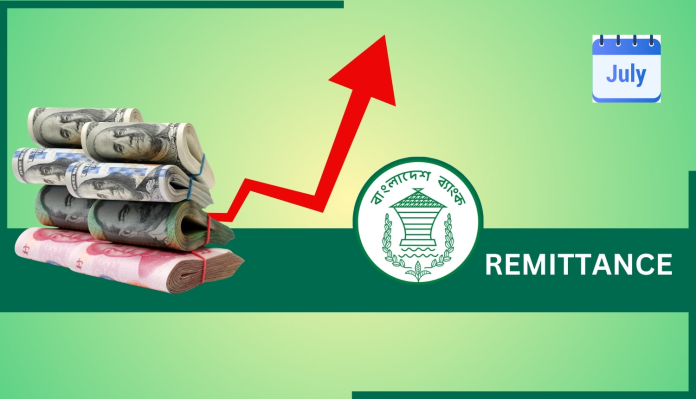
In July, the first month of the new fiscal year, remittances increased by 30% year over year, keeping inflows strong as over 40 lakh Bangladeshis had left the country for employment outside over the previous four years.
Remittances from Bangladeshi nationals living overseas totaled $2.47 billion last month, which helped the country improve its Balance of Payments—which keeps track of all transactions with the outside world—and progressively recover from its foreign exchange problem.
Bangladesh, which has been experiencing a foreign currency shortage for over two years, received $1.91 billion in July 2024, as reported by the Bangladesh Bank (BB).
However, the inflow for July was 12.22 percent lower than that of June, as many remitters had sent larger amounts home in anticipation of Eid-ul-Azha.
Industry experts attributed the increase in remittance inflows to various factors, such as a reduced disparity between official and informal exchange rates, stricter measures against money laundering, and a renewed sense of patriotism among expatriates following the political transition in August of the previous year.
A central bank representative noted that the use of hundi, an illegal method of cross-border transactions, has decreased, likely due to the political change, resulting in more remittances being funneled through formal banking systems.
According to BB, Islami Bank Bangladesh received the largest share in July, totaling $533 million, followed by Agrani Bank, Bangladesh Krishi Bank, BRAC Bank, Janata Bank, and Trust Bank.
By May of the current fiscal year, over 900,000 migrant workers had departed the country. In comparison, 1.2 million Bangladeshis sought employment abroad the previous year, marking the highest figure on record, as per the Bureau of Manpower, Employment & Training (BMET).
In its monetary policy for the July-December period, the BB stated that “the prevailing market-driven competitive exchange rate, strict oversight dismantling informal networks, and accessible agent banking and mobile financial services helped boost remittance inflow in this period.” Remittance inflow reached a record $30 billion in fiscal year FY25, indicating a 27 percent growth. With rising remittances, steady exports, and slower imports, the overall Balance of Payments posted a $3.3 billion surplus at the end of FY25, reversing a $4.3 billion deficit the year before.
According to central bank data, the country’s foreign exchange reserves stood at $24.77 billion as of July 31, up from $20.48 billion (BPM-6) during the same period last year.


