

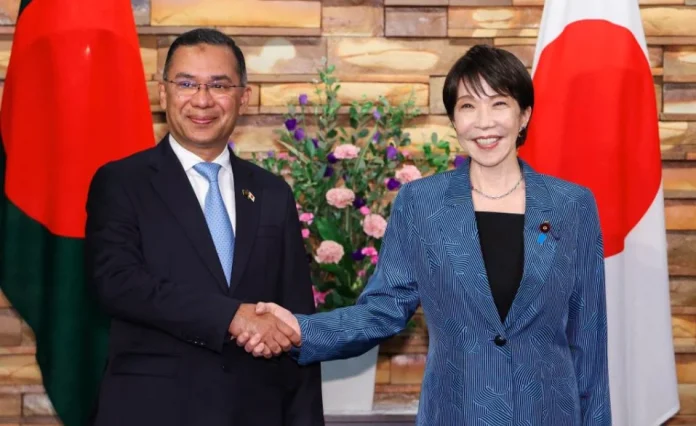
B Mirror Report: Bangladesh is seeking to attract up to 1 trillion Japanese yen, equivalent to around $6.3 billion, in private-sector investment over the next five years, with the potential to create approximately 200,000 jobs, Prime Minister Tarique Rahman has said.
The investment prospect emerged during his summit meeting with Japanese Prime Minister Sanae Takaichi in Tokyo, where the two leaders discussed expanding bilateral cooperation in energy, technology, manufacturing, transport infrastructure and trade.
In a Facebook post following the meeting, Tarique called for deeper ties between the two countries, saying stronger cooperation could pave the way for a more prosperous future.
He described the summit as productive, noting that both sides reaffirmed their commitment to democracy, the rule of law, economic development and stability in the Indo-Pacific region.
The prime minister said the discussions focused on translating the longstanding partnership into practical benefits for the people of Bangladesh, particularly through investment, industrial expansion and employment generation.
The two sides also explored 50 billion Japanese yen, or approximately $320 million, in emergency financial assistance under Japan’s Partnership for Power Asia initiative to strengthen Bangladesh’s energy security.
Tarique said prospective Japanese investments could accelerate industrialisation, expand manufacturing capacity and open up new opportunities for the country’s young workforce.
Technology cooperation was another priority. He proposed establishing a Bangladesh-Japan Tech Park to facilitate collaboration in artificial intelligence, cloud computing, robotics, electronics manufacturing and other advanced technologies.
The discussions also covered space science, satellite engineering and Japanese technical and financial assistance for high-speed rail connectivity linking six major divisional cities, alongside the development of modern transport infrastructure.
Both countries agreed to advance the Bay of Bengal Industrial Growth Belt (BIG-B) initiative under a renewed framework for shared prosperity. The initiative is expected to promote integrated development in energy, deep-sea ports, industrial infrastructure, technology and regional connectivity.
Tarique said the cooperation would help strengthen Bangladesh’s position as a bridge between South and Southeast Asia.
He also emphasised the early implementation of the Bangladesh-Japan Economic Partnership Agreement (EPA), signed in February 2026, and proposed establishing a ministerial-level joint commission to improve coordination and turn bilateral commitments into concrete results.
On the Rohingya issue, the prime minister thanked Japan for its continued humanitarian support and called for sustained Japanese engagement to ensure the refugees’ voluntary, safe, dignified and sustainable return to Myanmar.
He also acknowledged Japan’s longstanding contribution to Bangladesh’s development, recalling the role of his father, Shaheed President Ziaur Rahman, in laying the foundations of bilateral relations and his late mother, former prime minister Khaleda Zia, in further strengthening the partnership.
Japan was among the first countries to recognise Bangladesh’s independence and has remained a trusted development partner, Tarique said, expressing gratitude for its continued support.
He added that his government aimed to build an investment-driven economy through innovation, infrastructure development and the creation of meaningful jobs.
The four-day official visit, from October 26 to 29, was undertaken at the invitation of Takaichi, with the two sides seeking to strengthen their strategic partnership, expand trade and accelerate development cooperation.
During the summit at the Japanese Prime Minister’s Office, the leaders discussed energy security, information and communication technology, railways, infrastructure, deep-sea ports and foreign investment. They also issued a joint press announcement on the outcomes of their talks and exchanged several memorandums of understanding.
Tarique is also scheduled to address the Bangladesh-Japan Economic Forum and meet Japanese business leaders. Meetings with development institutions and visits to industrial and energy facilities are intended to identify additional avenues for investment and cooperation.


