

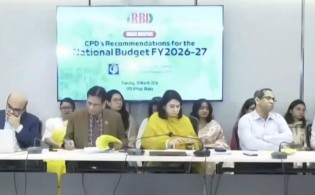
B Mirror Report: Economists have identified controlling inflation, increasing investment, and creating new jobs as the three biggest challenges in preparing the country’s upcoming budget.
They say restoring macroeconomic stability will be crucial for the government in the fiscal year 2026–27 budget, considering the current economic situation.
At a press conference on Tuesday, the private research organisation Centre for Policy Dialogue (CPD) said special emphasis should be placed on creating an investment-friendly environment and expanding employment opportunities while formulating the new budget. The organisation also recommended prioritising economic stability.
Speaking at the briefing, CPD Executive Director Fahmida Khatun said the main objective of the next fiscal year’s budget should be to restore balance in the economy. In the short term, she stressed that controlling inflation must receive the highest priority. At the same time, policy support should be provided to encourage new investment and expand employment opportunities.
CPD’s analysis shows that the financial situation in the current fiscal year (2025–26) has been weaker than expected. Tax revenue growth collected by the National Board of Revenue (NBR) increased by 12.90 percent between July and January, which is far below the target. To meet the goal, the tax collection rate would have to rise to 59.40 percent between February and June, which analysts say is unrealistic under the current circumstances.
According to the research organisation, the government’s revenue shortfall reached nearly Tk 60,000 crore in the first seven months of the fiscal year, putting additional pressure on public financial management.
CPD also noted that progress in development activities has not been encouraging. From July to January of the current fiscal year, the implementation rate of the Annual Development Programme (ADP) stood at only 20.30 percent the lowest in the past 15 years.
Meanwhile, inflation has become a major concern for ordinary people. In February 2026, point-to-point inflation rose to 9.13 percent. Food inflation stood at 9.30 percent, while non-food inflation was 9.01 percent. CPD said the rapid rise in the cost of living has increased pressure on people, particularly those with low incomes.
The organisation also expressed concern over the slow flow of credit to the private sector and warned that the government’s increasing borrowing from the banking system could pose risks to investment. According to CPD, if the government borrows more from banks, opportunities for private sector investment may shrink.
To accelerate economic recovery, CPD recommended providing special incentives to small and medium enterprises. It also urged expanding social safety net programmes and increasing allocations for the health and education sectors. The organisation believes the upcoming budget presents an important opportunity for the government to restore macroeconomic stability and lay the foundation for sustainable long-term growth.

