

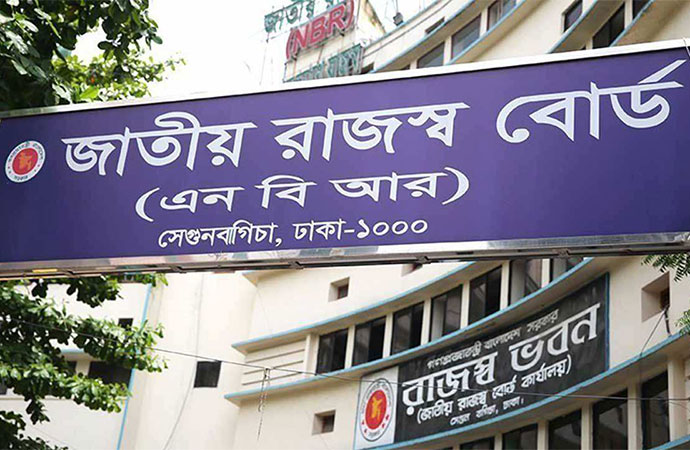
The International Monetary Fund (IMF) has sought an update on the government’s plan to split the National Board of Revenue (NBR) into two separate entities and asked for details of Bangladesh’s strategy to raise its tax-to-GDP ratio, one of the lowest in the world.
The issues were discussed at a high-level meeting held at the NBR headquarters in Agargaon on Monday, officials said on Tuesday.
The meeting was led by NBR Chairman Ahsan H. Habib, while the IMF delegation was headed by Bangladesh Mission Chief Ivo Krznar. Discussions focused on the new national budget, the revenue shortfall, the medium-term budget framework, and domestic financing.
During the meeting, NBR officials reiterated that the government remains committed to its policy decision to divide the tax authority into a Revenue Policy Division and a Revenue Management Division to improve transparency, efficiency, and accountability. Officials assured the IMF that visible progress on the restructuring would be seen soon.
Under the proposed structure, the Revenue Policy Division will be responsible for tax legislation, policy research, and international coordination, while the Revenue Management Division will oversee tax collection, audits, and field-level operations.
Although parts of the restructuring ordinance faced opposition from a section of NBR officials and employees, the government has decided to revise the ordinance based on stakeholder feedback instead of scrapping it entirely.
The NBR also informed the IMF that it plans to raise the tax-to-GDP ratio through full automation of tax administration, expanding the tax base, curbing tax evasion, and strengthening the collection of outstanding revenues. Officials said the government intends to widen the tax net to district and upazila levels without increasing tax rates and has avoided introducing new tax exemptions except where necessary.
According to the IMF, Bangladesh’s tax-to-GDP ratio is currently among the lowest globally, ranking only slightly above Yemen and Sudan.
Finance Minister Amir Khasru Mahmud Chowdhury said in his June budget speech that the ratio currently stands at 6.8%. The Ministry of Finance’s Medium-Term Macroeconomic Policy Statement for 2026-29 targets increasing it to 10.7% by fiscal year 2028-29.
The IMF also sought details of the government’s strategy to achieve its ambitious revenue collection target of Tk 6.04 trillion in FY2026-27 after the NBR missed last fiscal year’s target by nearly Tk 1 trillion.
The IMF delegation is visiting Dhaka for five days as part of discussions on a possible new lending programme worth between $4.5 billion and $5.0 billion. Officials said the delegation took note of the NBR’s plans and is expected to present its observations in subsequent meetings.
According to the Ministry of Finance, the government is also planning a Tk 600 billion financing programme to revive closed industrial units and has initiated the process of transferring management of 44 state-owned industrial enterprises to the private sector to boost investment. Future discussions with the IMF are expected to cover progress on the new loan programme, delays in project implementation, and financing for a new national pay scale.

 has sought an update on the government's plan to split the National Board of Revenue (NBR))