

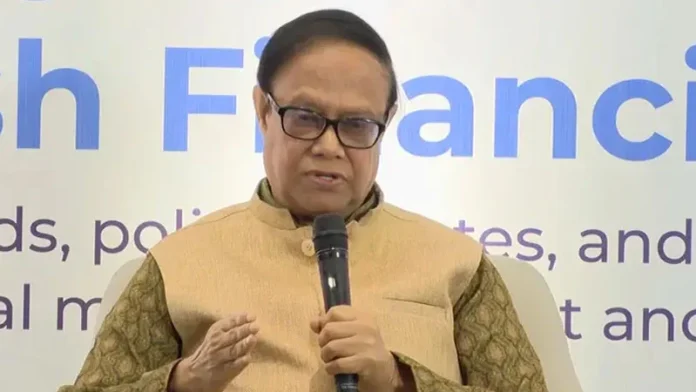
Bangladesh Bank Governor Dr. Ahsan H. Mansur hopes that inflation will come down to 7 percent by June. He said that the government aims to bring inflation down to 5 percent in the next fiscal year. For this, along with following a strict monetary policy, customs duties on essential food imports have been lifted. If inflation does not come down by January, the monetary policy will be tightened further.
He said these things while speaking as the chief guest at an investor conference organized by brokerage house BRAC EPL and consulting firm Asian Tiger Capital Partners at the Sheraton Dhaka Hotel in the capital last Thursday night. Eminent economist Dr. Zahid Hossain presented the keynote paper at the conference. Economist Dr. Masrur Riaz, Professor Mostaq Hossain Khan, BRAC Bank MD Selim RF Hossain, DBA President Saiful Islam, an organization of brokers of DSE, participated in the discussion. Asian Tiger Capital Chairman Ifti Islam moderated the discussion. Investors from various countries, including the United States, participated in the event.
Governor Ahsan H. Mansur commented that all the problems the government is facing now are inherited. He said that the biggest problem now is inflation. Everything that the government and Bangladesh Bank could do to control it has been done. Despite that, there is disappointment, inflation is still not coming down. Monetary policy has been tightened enough to reduce inflation. The central bank has not given a single taka to the government. The government has taken loans from banks when needed. The government has also reduced spending, trying to keep the internal debt of the budget at a reasonable level.
The governor said that the shortage in supply of goods has become a big problem. There were floods in August and September, and the rainy season was also long. Due to this, crops like onion, potato and winter vegetables could not reach the market within the normal time. There has been a delay of one to two months. He hopes that there will be a good yield of onion and potato and it will come down to 30 taka and 40 taka after two months.
He said, “The government has lifted all import duties on essential food items to ensure supply. We have left nothing to do to make the prices of onions, oil, sugar, and basic food items a little more bearable for consumers. I am expecting some results by February. Now the policy interest rate is 10 percent and the loan interest rate is around 14 percent or so. This is probably the highest. If I see that inflation has not come down by January, I will have to take a more stringent monetary policy.” Tightening the monetary policy means that the policy interest rate will increase further. And the interest rate on bank loans will also increase due to the increase in the policy interest rate.
Ahsan H. Mansur said, “Our goal is to bring inflation down to 7 percent by the end of June and to reduce it to 5 percent in the next fiscal year. The lesson we have learned from the US, UK, European Union or Thailand and other countries to control inflation is that it will take at least a year to fix it. We have to give it that time. The medicines that can be applied for this have been applied. We are now waiting for the results.”
He said, the three major challenges in the economy are – weakness of the external sector, inflation and weak banking sector. The interim government inherited a deficit of $2.5 billion in foreign payments. Reserves were also continuously decreasing. There were problems with imports as foreign banks were not willing to open LCs. The current government is four months old. In this short period, the problem of opening LCs has been solved. Where LC bill payments were over $2.5 billion, now it has come down to $300 million. Efforts are being made to resolve the problem by talking to the banks. The goal is to bring it down to zero.
The governor said, “I will not tolerate a single LC bill being left unpaid. I have clearly told the banks that if an LC is opened, whether it is opened by S Alam or anyone else, it is the bank’s responsibility. The bank itself will have to settle it. I am hopeful that the bills that are still outstanding will be cleared within a month.”
The governor believes that solving the problem of the sector is not easy as the banking sector was looted under the patronage of the state in the past. He said, everyone knows that the banking sector was looted under the patronage of the state. 87 percent of the loans from a bank were given to a family or their children. Such incidents have occurred in several banks. The money was laundered abroad. To solve the problem, a draft of the Bank Recovery Act has already been prepared, under which the central bank has been given the power to take strict and practical measures as needed, such as liquidation, merger, and forcing it to take new capital.
Ahsan H. Mansur said that the US and UK governments are being contacted to recover the money laundered abroad, “We have contacted the European Asset Recovery Program, the World Bank Group. We are getting great support from these organizations. The US Treasury has already visited twice and they will come again in January. Hopefully, we will get international and political support to recover the money.” He said that he wants to leave a good overall macroeconomic situation for the next elected government by solving various problems systematically.
In the main article, Dr. Zahid Hossain said that the new government is trying to bring economic management back to normal. Currently, the dollar is overvalued. If it decreases, it will help reduce commodity prices and inflation. However, inflation cannot be brought down through monetary policy alone. For this, he recommended ‘market policing’.
Professor Mostaq Hossain Khan said that the main reason for corruption is the lack of good governance. Corruption exceeded the limit during the previous government. Business forums were also politicized. Their discussions would start with the worship of the head of government and the party. Without political connections, no one would have expected to get business in the competition.
Salim RF Hossain, Managing Director of BRAC Bank, said, after the August 5 coup, many people were worried that the country would fall into an economic recession. Fortunately, that did not happen. Now, 30 to 40 percent more remittances are coming in every month. While some banks are in trouble, there are many banks that do not have any liquidity crisis.

