

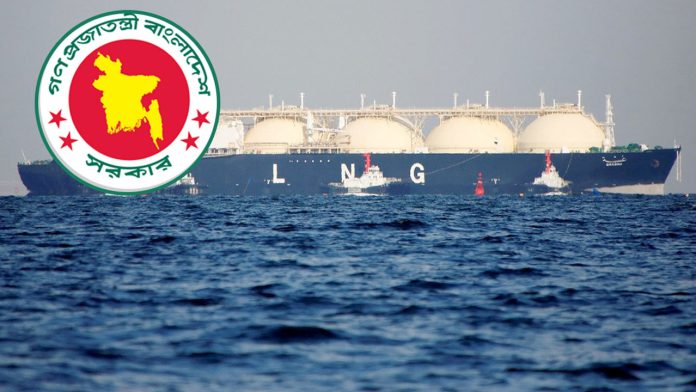
B Mirror Report:The government has approved an additional Tk24,000 crore in subsidies to cope with rising energy import costs following a surge in global fuel prices triggered by escalating tensions in the Middle East.
Officials said prices of liquefied natural gas (LNG) and refined fuels jumped after the recent US-Israel attack on Iran and the resulting disruption of shipping through the Strait of Hormuz, causing volatility in global energy markets.
Of the newly approved subsidy, Tk17,000 crore will be allocated to support LNG imports, while Tk7,000 crore will be used for fuel imports, mainly to offset the rising cost of diesel purchased by the state-run Bangladesh Petroleum Corporation (BPC).
Confirming the development, Energy Secretary Mohammad Saiful Islam said the government decided to increase subsidies to meet the higher import costs of LNG and fuel during the current fiscal year.
The decision followed an urgent virtual meeting on Wednesday involving officials from the energy ministry, finance ministry and several other ministries. The meeting was called after a revised subsidy proposal was submitted by Petrobangla to the Energy Division.
Officials said the subsidy calculation was based on several price scenarios involving projected Brent crude and spot LNG prices for the April–June period. Under the scenario selected by policymakers, Brent crude is assumed to average around $90 per barrel while spot LNG prices remain near $20 per MMBtu.
Under this projection, importing the originally planned 31 LNG cargoes would require Tk20,000–Tk21,000 crore in subsidies. If imports are reduced to 25 cargoes, the subsidy requirement would still be around Tk16,000–Tk17,000 crore.
The latest decision significantly raises the government’s LNG subsidy burden for the fiscal year.
Earlier, the government had allocated Tk6,000 crore for LNG subsidies in FY2025-26. With the additional Tk17,000 crore, the total LNG subsidy will rise to about Tk23,000 crore.
Officials said the increase was mainly driven by soaring spot LNG prices and supply disruptions from long-term contracts, as several suppliers invoked force majeure amid geopolitical tensions and shipping disruptions.
Bangladesh has recently placed spot LNG orders at prices between $21.58 and $28 per MMBtu, much higher than prices under long-term agreements.
Despite the higher subsidy allocation, LNG imports are expected to decline in the final quarter of the fiscal year due to budget constraints.
Bangladesh had initially planned to import 31 LNG cargoes between April and June. That plan has now been revised down to 25 cargoes.
According to officials at the Power, Energy and Mineral Resources Division, maintaining the original import plan would require an additional Tk6,000–Tk7,000 crore in subsidies, which would be difficult to manage given fiscal pressures.
Overall, Petrobangla had planned to import 115 LNG cargoes in FY2025-26, including 103 cargoes under long- and short-term contracts and 12 cargoes from the spot market. However, supply disruptions have forced the country to rely more heavily on costly spot purchases.
Petrobangla Chairman Md Arfanul Hoque warned that reducing LNG imports could affect key sectors of the economy.
He said lower gas supply could have a serious impact on power generation, fertiliser production and industrial output.
The sharp rise in global oil prices has also increased pressure on BPC. Although the corporation recorded profits in recent years due to relatively low international oil prices, the recent surge in diesel prices has raised import costs.
Diesel prices under the Singapore benchmark, widely used in Asian refined fuel trading, jumped from around $89–$90 per barrel before the escalation of the Iran-related conflict to roughly $143–$150 per barrel.
Energy officials said the government has therefore allocated Tk7,000 crore in subsidy support to help BPC manage the higher diesel import cost.
Officials warned that the rising subsidy burden highlights Bangladesh’s vulnerability to global fuel market shocks, particularly due to its heavy reliance on imported LNG and petroleum products. If tensions in the Middle East persist, policymakers fear further volatility in energy markets in the coming months.

