

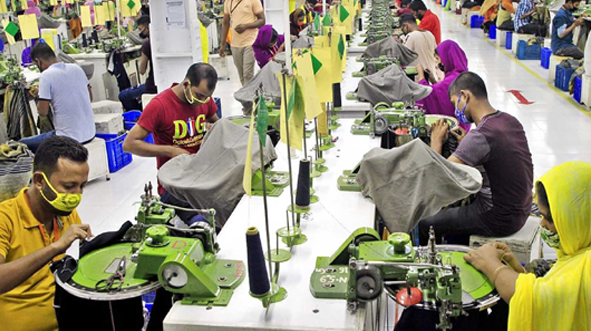
Bangladesh’s apparel industry continues to hold a strong position in the global sourcing market despite a sharp decline in factory utilisation among US fashion companies, according to the 2026 USFIA Benchmarking Study.
The report, released by the United States Fashion Industry Association (USFIA), showed that Bangladesh’s utilisation rate fell to 78.9 percent in 2026, down from 88.2 percent a year earlier, as American apparel brands increasingly diversified their sourcing networks to reduce risks and improve supply chain flexibility.
Although utilisation declined, Bangladesh remained among the world’s most-used sourcing destinations, alongside Vietnam, Cambodia and Indonesia. The study noted that the trend was not unique to Bangladesh, as utilisation rates also dropped across major Asian suppliers. China’s utilisation rate declined to 73 percent, while Vietnam’s fell to around 78 percent, both from 100 percent in 2025.
The report attributed the shift to changing sourcing strategies rather than weakening confidence in Bangladesh. US buyers are increasingly balancing production across multiple countries to enhance resilience, improve inventory management and reduce dependence on a single market.
Trade uncertainty remains a major concern for the industry. According to the survey, 92 percent of participating companies identified US protectionist trade policies and tariff uncertainty as their biggest business challenge in 2026. The average US tariff on apparel imports rose to 21.6 percent in May 2026, compared with 15.2 percent before President Donald Trump’s second administration took office.
The study found that China and Vietnam are considered the most vulnerable to future US trade restrictions, while Bangladesh, India and Cambodia face a comparatively moderate level of risk.
Despite the lower utilisation rate, Bangladesh achieved a significant milestone in the US market. During the January-May period of 2026, it overtook China to become the second-largest supplier of apparel to the United States by value, accounting for 11.3 percent of total US apparel imports. Vietnam maintained the top position with a 22.2 percent market share, while China’s share fell to 9.7 percent.
The survey also highlighted Bangladesh’s strategic importance to global brands. Nearly 47 percent of US fashion companies surveyed said Bangladesh accounts for more than one-tenth of their global apparel sourcing volume or value.
However, the report pointed to several areas requiring improvement to sustain long-term competitiveness. Bangladesh received a 2.3 out of 5 rating for speed-to-market, reflecting challenges related to long lead times, logistics and supply chain responsiveness. It also scored 2.6 for its ability to accommodate small and specialised orders, suggesting that the country’s garment industry remains largely geared toward large-scale production of basic apparel.
Bangladesh performed relatively better in vertical manufacturing capability, earning a score of 3.4, but still lagged behind China (4.8) and India (4.0).
The report further noted that Bangladesh continues to face challenges in labour and environmental compliance, scoring 2.2 and 2.4, respectively. It said improving workplace standards, environmental sustainability and supply-chain traceability will become increasingly important as global brands comply with stricter regulations, including the Uyghur Forced Labor Prevention Act and emerging environmental due diligence requirements.
Looking ahead, the outlook for Bangladesh remains encouraging. The study ranked the country as the second-most attractive destination for future sourcing expansion, behind Indonesia, with 46.7 percent of surveyed companies planning to increase sourcing from Bangladesh over the next two years.
According to USFIA, Bangladesh is well-positioned to remain a leading global apparel sourcing hub through 2028 if it can strengthen logistics, reduce lead times, expand domestic textile production, improve compliance standards and enhance manufacturing flexibility while preserving its cost competitiveness.

