

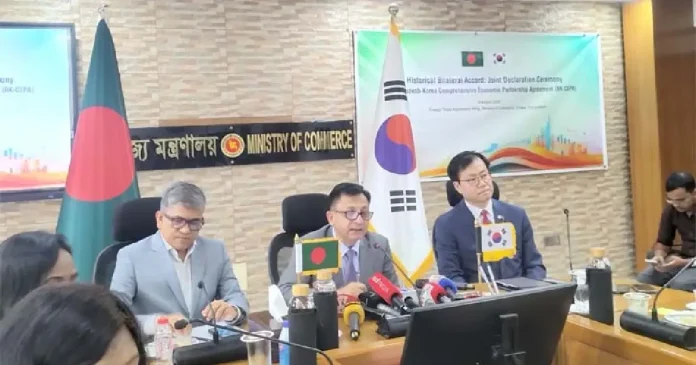
Bangladesh and South Korea have signed the long-awaited Comprehensive Economic Partnership Agreement (CEPA), granting preferential tariff treatment to the vast majority of goods traded between the two countries.
Under the agreement, 97% of Bangladeshi products will receive preferential tariff benefits in the South Korean market, while 87% of South Korean products will enjoy similar tariff concessions in Bangladesh.
The agreement was signed on Tuesday at the Ministry of Commerce. Speaking at a press briefing following the CEPA Negotiation Conclusion Ceremony, Commerce Minister Khandaker Abdul Muqtadir described the deal as a major milestone in expanding Bangladesh’s foreign trade.
The minister said the government had finalized its first free trade-based agreement with one of the world’s largest economies within five months of taking office.
He noted that Bangladesh’s key export sectors—including ready-made garments, leather and leather goods, and jute and jute products—will gain significant tariff advantages in the South Korean market. In return, Bangladesh will benefit from lower tariffs on imports of South Korean agricultural products, plastics and industrial spare parts.
Muqtadir said South Korea, with an economy of nearly $2 trillion, is an important trade partner for Bangladesh. He added that the government aims to transform Bangladesh into a $1 trillion economy by 2034 by achieving around 8% annual economic growth, with increased foreign investment playing a key role. Agreements such as the CEPA are expected to help attract more investment, he said.
South Korean Trade Minister Yeo Han-koo said the two countries have shared economic ties for 56 years, beginning with cooperation in the textile sector. He said the partnership is now entering a new phase and stressed the need to diversify exports and imports in line with evolving global trade trends.
Yeo expressed hope that Bangladesh’s economy would continue to strengthen under its new government and said cooperation in technology, industrial development, supply chains and manufacturing would expand further. He added that the implementation of the CEPA would encourage more South Korean companies to invest in Bangladesh, deepening bilateral economic and trade relations.


, granting)