

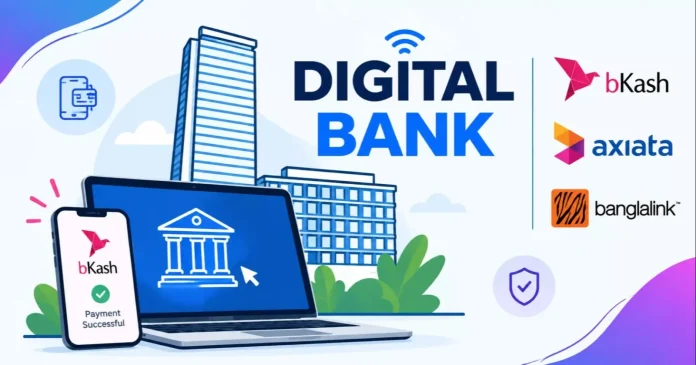
Bangladesh is moving ahead with plans to launch five new digital banks that will provide banking services without traditional branches, sub-branches or physical counters. Customers will instead access services through mobile applications and online platforms.
The new institutions will face several challenges before beginning operations, particularly in ensuring cybersecurity, protecting customer data and establishing effective risk-management systems.
At a recent meeting of the Bangladesh Bank Board of Directors, chaired by Governor Mostaqur Rahman, the central bank decided to grant preliminary approval to four new digital banks. The institutions are Digital Banking of Bhutan, bKash Digital Bank, Nova Digital Bank and Boost Digital Bank.
The board also decided to issue a Letter of Intent (LoI) to Kori Digital Bank, which had previously received preliminary approval.
The proposed digital banks have both domestic and international sponsors. Digital Banking of Bhutan is backed by Bhutan’s D.K. Bank. bKash Digital Bank is sponsored by shareholders of bKash. Nova Digital Bank is backed by VEON, the parent company of Banglalink, and Square Group. Boost Digital Bank is sponsored by Axiata Limited, the parent company of Robi.
Bangladesh Bank Executive Director and spokesperson Arif Hossain Khan said applicants had been given a number of conditions, including requirements related to cybersecurity. Once the institutions submit evidence that they have met the conditions, the central bank will review the documents before granting final approval if all requirements are satisfactorily fulfilled.
The process of establishing digital banks in Bangladesh began in 2023, when 52 domestic and foreign companies and consortiums applied for licences. At the time, preliminary approval was given to Kori and Nagad Digital Bank. Kori’s approval was later suspended after it failed to meet the required conditions. Bangladesh subsequently revised its digital banking policy.
Under the revised policy introduced in 2025, 12 institutions submitted applications for digital bank licences.
The capital requirement for digital banks has also been tightened. Under the revised guidelines, a digital bank must have a minimum paid-up capital of Tk 300 crore, up from the previous requirement of Tk 125 crore. Applicants and directors must also meet fit-and-proper criteria, while banks are required to demonstrate sound corporate governance and effective risk-management capabilities.
Unlike conventional banks, digital banks will operate entirely through digital channels. Customers are expected to be able to open accounts, deposit money, transfer funds, obtain loans and pay bills through websites and mobile applications.
The branchless model could reduce the operating costs associated with physical banking infrastructure while enabling banks to deliver services more quickly to customers.
Increasing financial inclusion is another key objective of digital banking. The new institutions could help bring people who remain outside the conventional banking system, as well as small entrepreneurs and businesses, into formal financial services.
Digital banks may also be able to use customers’ transaction data to assess creditworthiness, potentially expanding access to loans for customers with limited traditional credit histories.
However, heavy reliance on technology will expose digital banks to a range of cybersecurity risks. Cyberattacks, theft of personal and financial information, identity fraud, account takeovers and online scams could pose significant challenges.
Protecting customer privacy will also be particularly important as banks increasingly use artificial intelligence and data-driven systems to assess borrowers’ creditworthiness.
As Bangladesh moves toward a branchless banking model, meeting capital and regulatory requirements alone will not be sufficient. The success of the new digital banks will also depend on their ability to build secure technology infrastructure, protect customer information and establish effective systems to identify and manage operational and financial risks.

