

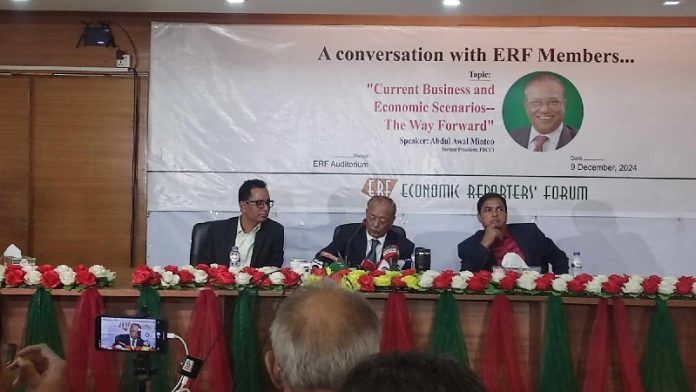
Former FBCCI President Abdul Awal Mintu said that to fix the capital market, the regulatory body must be fixed first. BSEC has made many new rules, regulations and laws to benefit people like this dervish. As a result, ordinary investors have suffered severely. That is why the regulatory body should be strengthened first.
He said these things at a discussion titled ‘Current Business and Economic Scenario – The Way Forward’ organized by the Economic Reporters Forum (ERF) on Monday (December 9).
He said, we have never been able to properly utilize our capital market. Instead of investing, they have considered the market as a place to play lottery. Instead of investing for the long term, they have bought it today like playing lottery, if the price goes up, they will be rich tomorrow.
Abdul Awal said, let the question of morality or immorality be on those who run the institutions. If the owner of Beximco Group has done wrong, he should be punished. The owner is to blame, not the institution. So the owner should be punished, not the institution. The Beximco institutions that I hear will be sold, who will sell them, why will they sell them? As a businessman, I think that the government should not take any such step in any productive sector that will disrupt the country’s manufacturing industry, as a result of which the workers will lose their jobs. If the Beximco Group’s owner officials have done wrong, I want them to be punished. But the government should not do anything that will disrupt the manufacturing industry.
He said, when judging the current state of the economy of any country, the first things that come to mind are various macroeconomic indicators, market management and economic policies. One of the main goals of macroeconomic policy is to increase “aggregate demand” or in economic terms, ‘GDP’ or ‘gross domestic product’. Then, to achieve this goal, appropriate policies should be formulated, implemented and implemented to increase the rate of economic growth.
Regarding instability in the economy, he said, whether it is economic growth or economic development, it is very necessary to have stability in the macroeconomics. However, the problem in maintaining stability in the macroeconomics is; first, to understand the complexities in the relationship between various indicators. Considering the current state of the indicators, plan to achieve positive results in them in the future. Then, move forward as planned to achieve the set goals. At the same time, control the unwanted negative consequences of any other indicator. Naturally, while bringing about desired changes in one indicator of the macroeconomics, another indicator may undergo undesirable changes.
He further said that a review of the current state of the economy shows that the previous government had turned dictatorship, arbitrary rule, partyization, and appeasing party members into state norms and policies. On the other hand, the previous government had taken over the institutions established for the welfare of the people and destroyed or weakened them through partyization. As a result, the market system was on the verge of collapse. As a result, instead of formulating and implementing appropriate policies and strategies for the welfare of the people, government institutions were busy formulating and implementing laws, rules and policies to help the looting of self-interested politicians, government officials, supporters of the ruling party, i.e. special interest groups.
Regarding the rationality of borrowing from local banks to meet the budget deficit, Abdul Awal said, if there is a deficit in the budget (government expenditure is more than income), the government is forced to borrow. For a developing country like Bangladesh, a rational level of budget deficit or expansionary fiscal policy is not undesirable. If the government borrows within a certain limit in a planned manner, it is not always harmful to the economy. However, unplanned and irrational excessive borrowing always creates problems for the economy. The purpose of borrowing and spending excessively (expansionary fiscal policy) is always the same in almost all countries. It is always said that the purpose of borrowing is economic growth. However, history testifies that political motives outweigh any economic motives behind excessive borrowing.

