

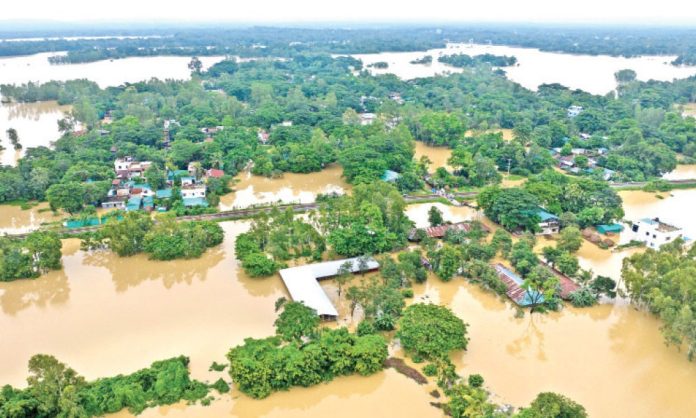
B.Mirror Desk: The country has been ravaged by the monsoon. Torrential rain and runoff from the hills have triggered a humanitarian crisis across the greater Chattogram region, leaving more than 150,000 people stranded by floodwaters. The flood situation has also deteriorated in other districts, with large parts of the country rapidly becoming inundated. If the situation persists, Bangladesh could soon face a major natural disaster. The floods are also creating fresh economic challenges, presenting the government with yet another formidable test.
It has been only five months since the BNP government assumed office. Ordinarily, a new administration enjoys a six-month grace period, often referred to as the “honeymoon period”. During this time, the public observes how the government performs, the opposition generally allows it some breathing space, and various pressure groups tend to exercise restraint. This enables a new administration to begin its tenure without excessive political pressure. However, the current BNP government has had no such honeymoon period.
The BNP inherited a country in a difficult state. According to its critics, the previous Yunus administration, despite pledging economic recovery, left the economy severely weakened. A series of murder cases were filed against private entrepreneurs, while incidents of looting and arson targeted industrial establishments. At the same time, industries faced severe shortages of gas and electricity. Faced with mounting uncertainty, many private investors chose to remain inactive. As a result, numerous factories closed, leaving an estimated 15 million people unemployed and another 20 million below the poverty line. Investment stalled, production slowed, and economic activity weakened significantly.
Against this backdrop, the BNP government, led by Tarique Rahman, initially concentrated on economic recovery. However, soon after it assumed office, conflict erupted involving Iran, the United States and Israel. The war disrupted global energy markets, sending fuel prices soaring. Like many other countries, Bangladesh also experienced a fuel crisis, although the government responded swiftly in an effort to contain its impact.
Domestic fuel prices were increased twice. The resulting rise in transport and production costs pushed up the prices of essential commodities, adding to inflationary pressures. The private sector, already weakened by earlier economic difficulties, came under renewed strain as businesses grappled with higher energy costs and supply shortages.
The Middle East crisis affected not only the energy sector but also Bangladesh’s export performance. The closure of the Strait of Hormuz disrupted trade, contributing to weaker exports. Instability in the region also affected Bangladesh’s overseas employment market. Before the government could fully assess the scale of the challenge, it found itself struggling to manage another external shock.
Bangladesh’s economy is now confronting multiple challenges. Persistently high inflation has eroded consumers’ purchasing power, reducing household spending and slowing business activity. Private sector credit growth has fallen to a historic low, while many businesses are struggling with shortages of working capital. Pressure has intensified across production, sales and investment.
The country’s export sector, its principal source of foreign exchange earnings, also remains under pressure. In the 2025-26 fiscal year, export earnings declined by 1.5% from the previous year to $35.57 billion. Earnings from ready-made garments (RMG), the country’s largest export sector, fell by almost 2% to $32.64 billion.
During the same period, imports increased by 6.2% to $54.80 billion. However, imports of industrial raw materials, intermediate goods and capital machinery declined, affecting manufacturing activity. Industrial production fell by more than 3% compared with the previous year, while private sector credit growth dropped to just 4.75%, its lowest level in two decades. By contrast, government borrowing expanded by 30.37% as the state relied heavily on both domestic and foreign financing.
The capital market also remains fragile. For more than two years, no new industrial financing has been raised through initial public offerings (IPOs). Many listed companies have postponed major investments and expansion plans as falling revenues and profits continue to squeeze businesses amid the prolonged economic slowdown.
The downturn has also affected employment. During the tenure of the former interim government, several industrial factories closed, leaving many workers without jobs. Most of those factories have yet to resume production, and redundancies continue. At the same time, sluggish business activity and weak investment are limiting the creation of new employment opportunities. During a visit to Bangladesh in March this year, Martin Raiser, the World Bank’s Vice-President for the South Asia Region, noted that while 14 million young people entered Bangladesh’s labour market over the past decade, only 8.7 million jobs were created. Nearly half of those entering the workforce therefore failed to secure employment.
Alongside domestic challenges, global developments have also increased economic risks. Analysts believe the tariff policies of US President Donald Trump and the energy crisis triggered by conflict in the Middle East will continue to generate uncertainty and weigh on Bangladesh’s economy for some time.
Against this backdrop, the BNP government, led by Tarique Rahman, presented its first national budget. The budget outlines a roadmap for overcoming the country’s economic difficulties, with particular emphasis on combating corruption, curbing money laundering and reducing wasteful expenditure.
However, at the very start of the new fiscal year, widespread flooding has created another major challenge. The floods have caused extensive damage to standing crops, homes, livestock, trees, fish farms, industrial facilities, businesses and biodiversity. Women, children, older people and persons with disabilities have been among the worst affected. Bangladesh already ranks poorly on the Global Food Security Index, and the floods have placed additional pressure on food security. Many low-income households have lost their food stocks, crops, poultry and fish farms, leaving them in an increasingly vulnerable position. Experts warn that the disaster will place further strain on the country’s already fragile economy.
The government is therefore confronting a triple challenge: dealing with inherited economic problems, managing the repercussions of conflict in the Middle East, and responding to the devastating floods. No government can overcome such challenges alone. The situation demands a united national effort.
The government, opposition parties and citizens from all walks of life must work together. Alongside the state, opposition parties, charitable organisations and those with the means to help should stand beside flood-affected communities.
Recovering from the economic damage will require collective action. This is not the time for political divisions, settling old scores or debating past responsibilities. The immediate priority must be to mobilise every available resource to respond to the disaster. The government’s foremost responsibility is to foster peace, stability and social cohesion so that people can put aside their differences and work together in the service of humanity. Comprehensive plans should be put in place without delay to meet post-flood needs, including food, healthcare and shelter, so that recovery efforts can begin as soon as the floodwaters recede.
Bangladeshis have repeatedly demonstrated remarkable resilience in the face of natural disasters. Time and again, the country has earned international recognition for its ability to confront such crises through courage, compassion and collective sacrifice. It must rise to the challenge once again. A united Bangladesh is an invincible Bangladesh.
National unity needed to confront disasters
Date:
Post View:
National unity needed to confront disasters


More like thisRelated
IMF satisfied with government’s reform efforts

Finance Minister Amir Khasru Mahmud Chowdhury said the International...
BSEC approves Rupali Bank’s Tk 680cr capital increase
The Bangladesh Securities and Exchange Commission (BSEC) has approved...
Former Pubali Bank Chairman Moniruddin Ahmed no more
Former Chairman and former Director of Pubali Bank PLC,...
Al-Arafah Islami Bank launches month-long SME training
Al-Arafah Islami Bank has organized a month-long specialized Entrepreneurship...