

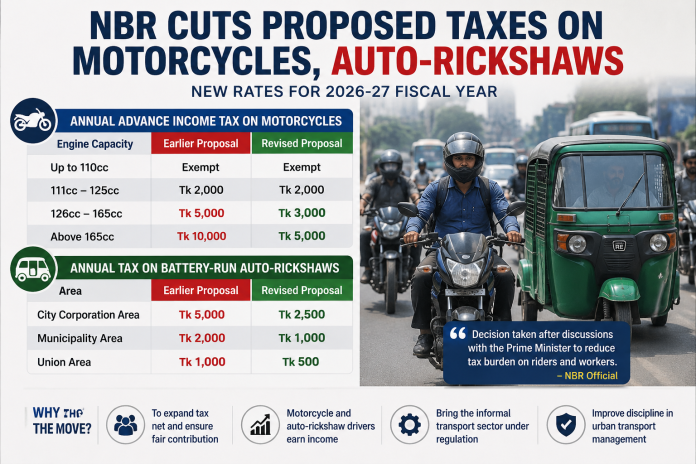
B Mirror Report: The government is set to bring motorcycles and battery-run auto-rickshaws under the tax net in the 2026–27 fiscal year, but the National Board of Revenue (NBR) has decided to reduce the proposed tax rates following strong reactions from riders and transport workers.
According to NBR officials, the revised rates were finalised after discussions with the prime minister, who instructed authorities to lower the tax burden considering motorcycles and auto-rickshaws as important transport services, especially in urban areas.
Under the revised proposal, motorcycles up to 110cc will remain tax-free. Bikes between 111cc and 125cc will face an annual advance income tax of Tk2,000, while the rate for motorcycles between 126cc and 165cc has been reduced to Tk3,000 from the previously proposed Tk5,000. For motorcycles above 165cc, the annual tax has been cut to Tk5,000 from Tk10,000.
The government has also lowered the proposed tax on battery-run auto-rickshaws. The revised rates set the annual tax at Tk2,500 for city corporation areas, Tk1,000 for municipalities and Tk500 for union-level areas nearly half of the amounts initially proposed in the draft budget.
NBR officials said the initiative aims to expand the country’s tax net and bring informal transport sectors under a more regulated framework.
They argued that motorcycle riders and auto-rickshaw drivers earn income through these vehicles and that the revised tax rates were kept reasonable. Officials also noted that most ride-sharing motorcycles fall below 165cc, meaning most riders would pay between Tk2,000 and Tk3,000 annually.
The proposal, however, sparked protests from bikers, who formed a human chain in front of the NBR headquarters on Sunday and submitted a memorandum demanding reconsideration of the tax.
The riders said motorcycles are no longer luxury items but essential vehicles used by office workers, students, small business owners and ride-sharing drivers. They also argued that owners already pay registration fees, road taxes, insurance costs and fuel taxes, making the new advance income tax an additional burden on middle- and lower-middle-income groups.
According to industry sources, Bangladesh currently has around 4.8 million registered motorcycles, most of them within the 100cc to 150cc range. Meanwhile, more than 5 million battery-run auto-rickshaws operate across the country, including around 1 million in Dhaka.
To regulate the growing three-wheeler sector, the government is also finalising the “Electric Three-Wheeler Management Policy 2025,” which will make registration, fitness certificates and tax tokens mandatory for battery-run auto-rickshaws.

