

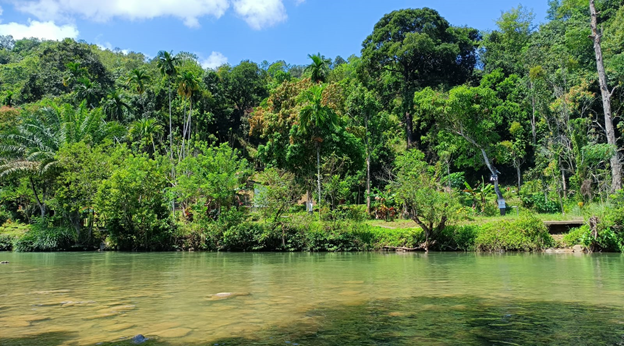
Mathura Bikash Tripura: The trip of April 9, to Kampung Tagal Babagon is a change for the senses. As the road winds up into the foothills of the Crocker Range, the air starts to shift. It becomes much cooler as it leaves behind the city noise of Penampang. The sky seems bigger here, with the jagged shapes of old trees and the far-off, misty peaks of Sabah’s interior framing it. When our van stopped, the humid air of the lowlands had been replaced by a cool wind full of oxygen that smelt like mineral-rich mountain water striking sun-warmed stones. As we got to the hamlet, the air was full with a lively, contagious energy right away. This was not the calm, respectful entrance of a normal tour group, it was a sensory overload. Before the official meeting could even start, our group of guests broke up and went their own ways. The Babagon River’s draw was like a magnet. The water here is more than just a part of the landscape. It is the landscape’s spirit. It is a clear, crystal-colored stream that flows over smooth, multicolored river stones. The continual, repetitive white noise it makes hides the troubles of the contemporary world.
It was like a dream. Some of the more daring attendees didn’t even wait for a tour since they were too hot after the trip. They took plastic chairs from the meeting area, waded into the cold, shallow water, and sat right in the flow. Their feet were in the whirling water as they sat there and spoke about what can only be called ‘gossiping on the river.’ It was a magnificent sight to see people interact with each other because of the river’s movement. In the meanwhile, the group’s shutterbugs were going crazy. Every viewpoint was a work of art- the way the sunshine came through the gigantic fern fronds, the moss-covered rocks that looked like sleeping giants, watching the fish gliding through the clear water, it felt as if they were the freest creatures on Earth and the bright dragonflies that flew over the surface like neon needles.
Even though Shree, Junia and other IPAS and PACOS team were asking people to come to the formal briefing, the call of nature was just too great to ignore. In areas like Babagon, there is a unique form of ‘nature-blindness’ that develops when the beauty of the surroundings makes it hard to hear what has to be done. After a few minutes of delicate prodding, the water’s magnetic pull finally gave way to the weight of our goal.
When the gathering eventually got beneath the shade of the community pavilion, the mood changed from wild excitement to calm, respectful anticipation. Three Rs are remembered by the participant- Respect, Responsibility, Reciprocity. Mr. Gidius Gonsuin was the guy who epitomized the spirit of our area. The head of the Tagal Babagon Committee was around 70 years old and seemed like a wise, dignified guy. His complexion was dark from years of sun exposure, and his eyes had the piercing, watchful look of someone who has seen the river change over the years. He stood in front of us not as a teacher, but as a keeper of tales.
Mr. Gidius started by taking us back to the 1950s, which seems like a whole other universe. Back then, Babagon wasn’t a busy ecotourism town. It was only a small locality of five families. Think about how lonely and close such existence would be. The area around it was a wild, uncontrolled stretch of primary rainforest and dense bush. This was a place of ghosts and shadows. It was a very important high-altitude transit hub for Indigenous peoples coming from the deep interior highlands to the coastal markets to barter their crops for salt, textiles, and iron.
Babagon became a safe place to stay since the trip was lengthy and the land was rough. People who travelled would come to the village tired, with big rattan baskets, and look for a place to stay. They didn’t stay at inns since there weren’t any, instead they stayed with benevolent or knowledgeable elders. Mr. Gidius remarked with much feeling on how these passengers came to see these temporary shelters as ‘a part of their own bodies.’ This wasn’t simply a metaphor for comfort, it was a sign of a kind of hospitality that has mostly disappeared from the world, a concept that the stranger is not a guest but an extension of the self.
He said that the name of the hamlet itself is a linguistic map of its past. It comes from the Kadazan word ‘Bagon’ or ‘Mabagon,’ which means ‘to sway’ or ‘swing.’ This was a literal description of the old suspension bridges (jambatan gantung) that used to cross the Babagon River. These bridges, which were composed of native vines and wood, would swing and dance dangerously when someone walked on them. To cross was to ‘mabagon.’ But Mr. Gidius quickly added a dimension of oral history that textbooks typically lack. He used the word ‘Tundo’ongon,’ which means ‘shelter’ or ‘resting area,’ to make his point. He said that Babagon’s identity was shaped not just by the bridges people crossed, but also by the rest they found when they got there. Babagon was known for its historical function as a place of rest for the tired, much as the adjacent important commerce city of Donggongon.
As the sun rose higher and formed dappled shadows on the gathering place, Mr. Gidius’s story became more serious. He reminded us that the river’s past has not always been a narrative of peace. The Kadazan people have fished for centuries with a strong reverence for the cycle of life. They employed bamboo traps and hand-cast nets that let the smaller fish get away. But the 1970s were a bad time for ‘progress.’
Greed that destroys arose with the rise of modern technologies. People started employing bleach, chemical poisons, and even other harmful ways to catch fish. They wanted to get the most out of their work with the least amount of effort. The results were terrible. The river, which used to be a source of life, turned into a cemetery. Mr. Gidius spoke of a period when the fish populations were so low that they were almost extinct, and the beautiful mountain air was replaced by the smell of rot and decay that hung over the lake. The river’s solitude was a scary reminder of what occurs when the ‘wiseman’s house’ forgets the wisdom of the land.
But the 1980s were a tipping moment. Elders who knew the ‘old ways’ urged the population to understand that if the river died, the hamlet would die too. They worked with the Fisheries Department to bring back the Tagal method, an old Indigenous tradition that was virtually lost.
In the Kadazan-Dusun language, the term ‘Tagal’ signifies ‘prohibition.’ It is a traditional way of managing resources that sees the river as a community-owned asset instead than a free-for-all. The Tagal Babagon project was officially launched in 2000. It was the first of its kind and the ‘birthplace’ of the current Tagal movement that has since spread throughout Sabah.
This is not a ‘soft’ environmental recommendation, it is a system based on customary law. Mr. Gidius said that the regulations are rigorously followed. If someone breaks the Tagal rules by fishing where they shouldn’t or at the wrong time, they don’t merely get a penalty. They are taken to the village chief, which is like a formal arrest. The penalties are meant to be a big burden on both society and the economy. A violation could have to give the community a pig or a cow. If they can’t give the animal as a fine, they have to pay the cash value, which is usually approximately RM 50 per kilogram for a 30-50 kg meat. This makes sure that the penalty of being greedy is far higher than the possible reward from the capture.
Tagal Babagon is absolutely amazing since it has grown from a basic fishing regulation into a full-fledged social safety net. As we strolled through the hamlet, we could hear the sounds of people working together, the distant ‘thwack’ of a machete, the laughing of children, and the continual flow of the water.
The hamlet has turned to eco-tourism as an indigenous economy system. The system is used as a method to pay for its conservation efforts. Visitors have to pay a little price of RM 3, but the regulations show that they cherish the elderly and the future generations, anybody over 60 or under 7 years old may get in for free. People don’t keep this money, it goes into a communal self-help fund. This fund works like an insurance policy for the community, giving money to families in need and helping Indigenous people with disabilities in particular. The people of Babagon take care of their own, and the river takes care of the people.
Managing the river itself is a great example of how to design space. It has three separate areas- Red Zone, Yellow Zone and Green Zone.
The Red Zone is a No-Go Zone. This place is a ‘no-take’ refuge. Fishing and any other activities that might harm the ecology are not allowed. The Red Zone provides a safe place for fish to develop and reproduce, so there is always a ‘seed’ population that can be used to fill up other portions of the river.
Yellow Zone is considered as a Zone with Limited Harvest of restricted zone. Fishing is usually not allowed here, however the area is available for a ‘harvesting festival’ once a year or every few years. The local Tagal committee picks the date, and the catch is normally divided evenly among all the people in the community or utilized for big cultural events like the Harvest Festival- Kaamatan.
Green Zone is known as an Open Zone. People may fish here all year round in a way that doesn’t harm the environment. It takes care of the residents’ everyday necessities.
One of the most moving things Mr. Gidius gave was the ‘Pregnancy Rule.’ The community knows what pregnant women need to eat because of their usual knowledge. The river gives pregnant women exclusive access to the fish, which makes sure that the next generation of Babagon’s offspring begins life with the vigor of the river. Both the men and women together decided when to fish for the pregnant women.
As the clock got closer to 12:40 pm, our group started to argue. We were at a crossroads of want. Half of the group was still asking questions about handicap rights, hunting restrictions, and how the Tagal system works. The other half, who were inspired by the mountain air and the smell of wood smoke, were starting to feel the keen pangs of hunger. After a short but fair ‘shouting match,’ it was determined that lunch would come first, followed by the tour.
We all ate lunch together, which was a feast of local greens, mountain rice, and the main dish of the day ‘Inava’.
We went to the ‘paddy classroom’ just after we ate. This is a little piece of land that is kept very clean and tidy, where the elders teach the young people how to farm. The community knows that if the kids forget how to cultivate rice, they will lose their connection to the soil in a world full of cellphones and cities. It was a little area of green, but it meant a lot for the survival of the culture. There were several small ponds, where fishes are grown. The new generation is taught how to grow fishes and catch them without harming the nature.
The highlight of the day was the cooking demonstration of Inava, the heart of Kadazan food. Many new variations of Inava include raw fish that has been cured in lime juice, like ceviche. But the teacher in Babagon told us a secret from the past.
To make real Babagon Inava, you need 300–500 gram of the freshest fish, such mackerel or tuna, or even better, a river fish with solid flesh. The fish is chopped into little, bite-sized pieces with surgical accuracy. The teacher stressed that the fish flesh had to be ‘blanched’ or cooked in warm water for a short time to have the right texture and taste for this rural ritual.
After the fish is ready, the mixing bowl is where the magic occurs. The fish is tossed with a lot of lime juice, which gives it a bright, sour top note. Then there’s the texture and heat, thinly sliced red onions for sweetness, spicy bird’s eye chillies for a kick, and a little bit of salt. The end result is a burst of taste that is sour, spicy, salty, and very fresh. No five-star restaurant could ever give you the same sensation as eating it while sitting by the river that supports the culture. We just had lunch before the village tour, but we’re still eating and consuming all the food like we’re going to assault it.
It was time to depart as the golden afternoon sun started to set behind the Crocker Range, spreading long, graceful shadows over the Babagon Valley. We had gone from a lot of noise and confusion when we first got there to a profound, peaceful feeling of thankfulness. The Malay Sea (the Tanjung Aru Beach) is calling us with her full of attractions.
Kampung Tagal Babagon is more than simply an effort to protect the environment. It is a classroom in real life. It shows us that moving forward doesn’t have to entail destroying the past. It teaches us that a community can build a system that is both fair and good for business when it takes care of its own resources.
As we drove away, I thought about Mr. Gidius’s remarks about the ‘wise man’s house’ as I watched the river run. In a world that frequently seems ‘mabagon’ unsteady and swaying because of climate change and social disconnection, places like Babagon are the Tundo’ongon. They are the places where we may relax, learn, and remember what it is to be a part of nature. The river and the bridges still waver, but the heart of Babagon is as firm as the old stones that are under the water.
—
The Author is National Awardee of the International Mother Language Award 2021 and Executive Director of Zabarang Kalyan Samity.


