

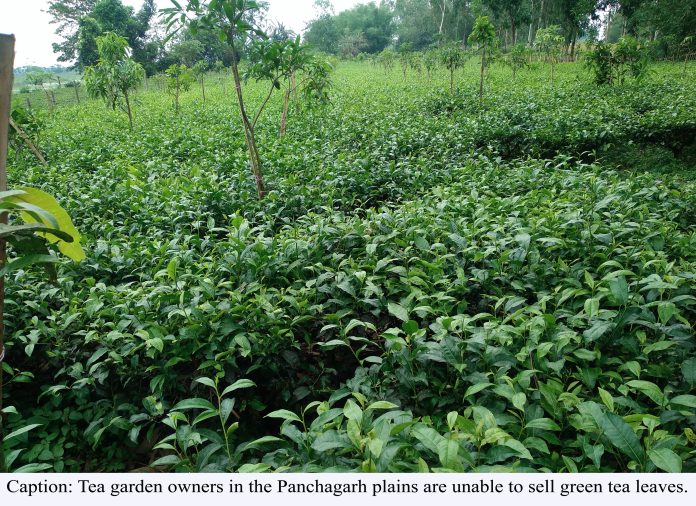
M.A. Based, Panchagarh Correspondent: Tea farmers across five districts in the Rangpur division are facing severe hardship due to the absence of fertilizer allocation for the tea sector, leaving thousands unable to care for their gardens during the critical season. As a result, production is under threat, with widespread outbreaks of leaf spot, bud rot, and pest infestations being reported.
Farmers in Panchagarh, Thakurgaon, Dinajpur, Nilphamari, and Lalmonirhat districts have expressed deep frustration as they battle increasing cultivation costs, adverse weather effects, and rising pest attacks — all without access to adequate fertilizer support from the government.
“Due to excessive rain and climate fluctuations, our gardens are under attack from pests like red spider mites and mosquito bugs. Without fertilizer, we cannot maintain our gardens, and production costs have doubled,” said Hafizur Rahman Khokon, a tea farmer from Sahebjot village.
Despite approaching local agricultural offices for help, farmers were told there is no fertilizer allocation for the tea sector under the Department of Agricultural Extension (DAE). The fertilizer shortage is particularly dire for small and medium-scale tea farmers, many of whom are unregistered and thus excluded from factory-based fertilizer distribution models.
According to the Bangladesh Tea Board’s Panchagarh regional office, tea is cultivated across 12,10,660 acres of flatland in the five districts, including 9 registered gardens, 21 unregistered gardens, and over 8,000 small-scale farms. The region produced 1.44 crore kg of tea last year, with hopes of crossing 2 crore kg this year.
However, this potential is at risk. Arif Khan, Officer-in-Charge of the Bangladesh Tea Board (Panchagarh Zone), acknowledged the problem, stating:
“The agriculture department does not allocate fertilizer for tea as it is an industrial crop. In Sylhet, factory owners receive fertilizer through the Ministry of Commerce and Ministry of Industries. But in the north, it’s difficult since many smallholders are not registered.”
He confirmed that the Tea Board has submitted a demand letter through the Ministry of Commerce to the Ministry of Industries, seeking fertilizer allocation for northern tea farmers. If approved, fertilizer would be distributed via registered dealers at fair prices.
Panchagarh Deputy Commissioner Md. Sabet Ali said efforts are ongoing to resolve the crisis:
“We have informed the Ministry of Commerce about the fertilizer shortage. Monitoring has been increased. The quality of Panchagarh tea has improved, and prices are rising in auctions. Ensuring fertilizer supply will help sustain this momentum.”
Meanwhile, the Department of Agricultural Extension (DAE) insists their mandate covers food crop production only. Deputy Director Abdul Matin said:
“The agriculture department can’t allocate fertilizer for tea, which is an industrial crop. That responsibility lies with the Ministry of Commerce or Ministry of Industries.”
Unless immediate steps are taken, the thriving tea industry in northern Bangladesh — particularly among smallholder farmers — risks major setbacks. Experts emphasize the need for a coordinated policy to include tea farmers in national fertilizer planning, especially as the crop becomes increasingly vital to the region’s economy.

