

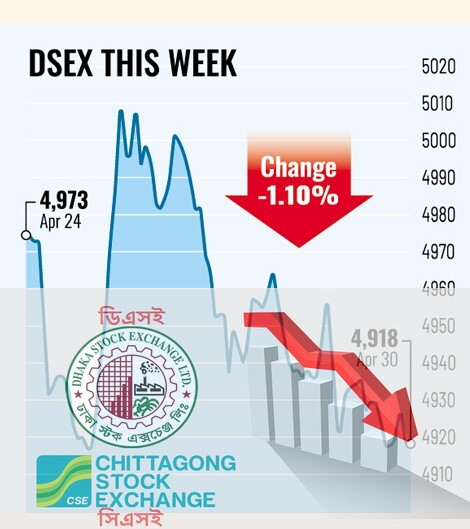
B Mirror Desk : The stock market continued its downward trend, marking a fourth consecutive week of losses as anxious investors persisted in their sell-off despite regulatory attempts to restore confidence. The prevailing bearish sentiment remains strong, with no immediate solutions in sight for the grim market outlook.
The securities regulator has implemented several measures aimed at boosting investor confidence, including easing negative equity provisions for market intermediaries and committing to support IPOs of well-performing and state-owned enterprises. To combat the decline in stock prices, the regulator has also increased the investment limit for the Investment Corporation of Bangladesh (ICB) in a single ‘A’ category stock, allowing for greater investment in quality stocks.
Meanwhile, the Bangladesh Securities and Exchange Commission (BSEC) has temporarily suspended 21 officials for misconduct during a protest against senior leadership in March. However, these efforts have not yielded positive results, as market volatility continued throughout the week, with sellers dominating amid uncertainty.
Although some investors were drawn to favorable earnings reports from certain companies, many chose to remain cautious, still affected by the ongoing downturn and losses in their portfolios. In an effort to minimize further losses, anxious investors continued to offload their holdings in the absence of strong catalysts.
As a result, the market closed in the red for three out of four trading days this week, with the DSEX, the benchmark index of the Dhaka Stock Exchange, dropping 55 points or 1.10 percent to close at 4,918, the lowest level in over six months. The prime index has lost 288 points over the past four weeks, while the market capitalization has decreased by Tk 173 billion.
Market analysts indicated that the extended downturn has led investors to avoid equity positions, resulting in increasing losses within their portfolios as the struggling market lacks significant catalysts to restore investor confidence. EBL Securities, in its weekly report, noted that despite the liquidity relief measures implemented by the securities regulator, including the easing of negative equity provisions for market intermediaries, these efforts have not succeeded in reversing the ongoing market decline.
According to a stockbroker, investors are remaining cautious, closely observing quarterly earnings reports from listed companies, and are opting to shift their investments into stocks with promising earnings forecasts for a potential quick return in the challenging market.
A prominent broker, who wished to remain anonymous, stated that investors have been enduring a significant crisis of confidence for an extended period, which has been further exacerbated by the potential effects of sudden gas price increases and political instability. The persistent macroeconomic difficulties, along with disappointing quarterly earnings from several major companies, have also negatively impacted investor sentiment. He added that the ongoing market decline has led to many margin accounts being forced into sales, further intensifying the drop in the index.
Nevertheless, he emphasized that now is an opportune time to invest in quality stocks, as many well-performing stocks have reached attractive price levels following significant corrections. The decline in prices of select stocks, including Grameenphone, BAT Bangladesh, Power Grid, Square Pharma, Trust Bank, National Bank, and Prime Bank, contributed to a substantial decrease in the prime index, which fell by half this week. The considerable price drop of blue-chip stocks also caused the DS30 index, representing 30 leading companies, to decrease by 22 points to 1,823, while the DSES Index, which includes Shariah-compliant companies, fell by 11 points to close at 1,094.
This week, the total turnover on the main stock exchange reached Tk 14.10 billion, a decrease from Tk 17.18 billion the prior week, which had five trading days. Nevertheless, the average daily turnover rose to Tk 3.53 billion, reflecting a 2.6 percent increase from last week’s average of Tk 3.44 billion. The banking sector was the most active, contributing 16 percent to the total turnover, followed by the food sector at 14 percent and the power sector at 11 percent.
Most major sectors experienced declines, with the telecom sector suffering the largest drop of 5.13 percent, along with losses in non-bank financial institutions, food, banking, and engineering sectors. Out of 394 stocks traded, 199 saw a decline, 158 increased, and 37 remained unchanged on the DSE trading floor. Square Pharma was the top-traded stock, with transactions totaling Tk 1.15 billion, followed closely by Beach Hatchery, Midland Bank, Lovello Ice-cream, and BRAC Bank. The Chittagong Stock Exchange also closed lower, with the CSE All Share Price Index (CASPI) dropping 151 points to finish at 13,805, while the Selective Categories Index (CSCX) decreased by 96 points to 8,428.

