

Senior Correspondent:
The International Monetary Fund (IMF) has emphasized the need for Bangladesh to introduce flexibility in its reform agenda to tackle challenges in the financial account, says IMF Asia and Pacific Department Director Krishna Srinivasan.
Srinivasan highlighted Bangladesh’s progress in monetary policy and fiscal performance, but noted concerns regarding the financial account’s performance, which has led to pressure on the country’s reserves and currency.
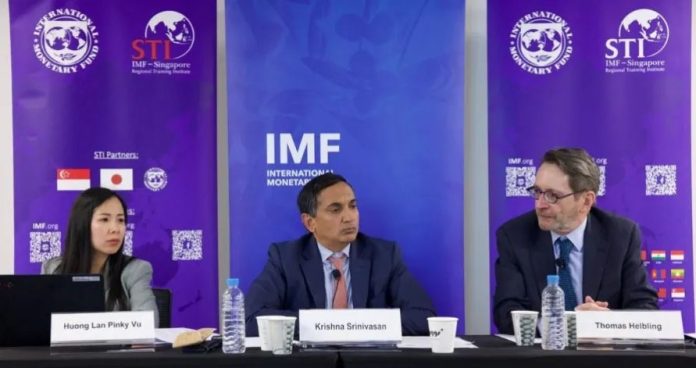
Krishna Srinivasan made the comments at a press briefing titled “Regional Economic Outlook for Asia and Pacific,” organized by IMF in association with Singapore Training Institute (STI) in Singapore on Tuesday.
IMF Communications Officer Huong Lan Vu moderated the session while Krishna Srinivasan made the welcome remarks.
In reply to the question regarding economic outlook of Bangladesh, Srinivasan said, “Bangladesh was a country which proactively reached out to the IMF support for its home grown program, which has two components. One is macro stability and addressing the longer structural issues related to climate change.”
“As emerging markets and developing economies there have been significant improvements on macro performance so far. You know, just to give a number, growth in 2024 was 5.7 per cent and in 2025 we have it at 6.6 percent though it was 6 per cent last year.”
He added, “I think we’re Bangladesh was struggling a little bit because the current account was adjusted well partly because, you know, the financial account wasn’t doing better.
“You could see that in the bleeding of reserves and the taka coming under pressure now. So it is important that the next stage of the reform agenda is to allow flexibility, which would help you address the problems in the external sector, in the financial account.”
Srinivasan then said, “Once you do that, you will see a greater sense of stability coming back in the external accounts, which in tandem with improvements the government is making on the fiscal.
“You should see more sustained recovery from the crisis that every country has faced in the region because of multiple shocks and rust starting from the Covid pandemic.”
Regarding the Asia Pacific outlook, he said the region is marked by both resilient growth and rapid disinflation.
Growth is better than previously projected but will slow from 5 per cent in 2023 to 4.5 per cent in 2024. The region remains inherently dynamic and accounts for about 60 percent of global growth.
Thomas Helbling, division chief, research department, IMF University of Geneva, Washington was also present at the briefing.


