

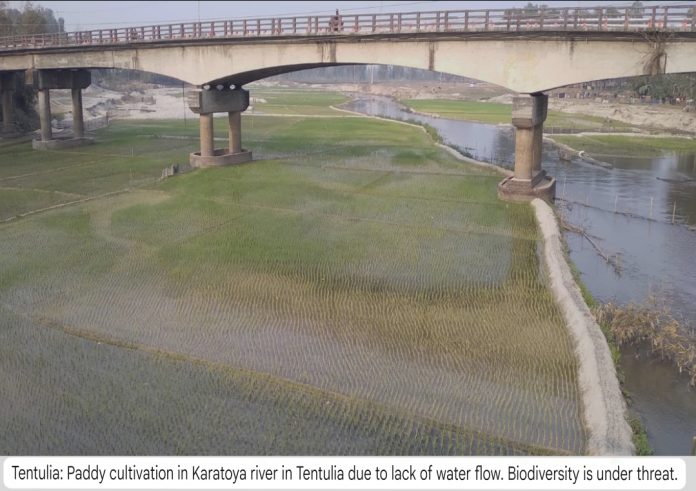
Md. Abdul Based Panchagarh : 39 rivers, including 6 major rivers, do not have proper water flow. Natural biodiversity is under extreme threat.
According to Bangladesh Water Development Board Panchagarh sources, there are a total of 39 rivers in the district, including 6 major transboundary rivers and 33 internal small rivers. The major rivers are Mahananda, Karatoya, Chawai, Patharaj, Ghoramara and Talma.
The sources of these rivers are from neighboring countries India and China. India built dams upstream of these major rivers and diverted the flow of the river, causing the rivers to dry up and turn into dead streams in the dry season. As a result, the flow of water in the internal small rivers also stopped.
Now, in some places, there are dusty sandbanks on the banks of the rivers, and in some places, there are green crop fields. Due to the lack of water flow in the rivers, various species of aquatic plants, fish and other aquatic animals are now on the verge of extinction. The rivers bear geographical importance in the history of Tentulia in Panchagarh district and the development of the tourism industry.
The Chawai River divides the boundary of Tentulia upazila with Panchagarh Sadar. Big and small rivers flow from India and flow through Panchagarh district and flow into the downstream country. The Mahananda River also flows along the Himalayan mountains of Nepal and the Sikkim state of India. The Mahananda River flows along the Indian border and separates the India-Bangladesh territory at the Bangladesh border at a place called Banglabandha Jhar-Yapara.
This Mahananda flows about 30 kilometers from Jharuapara along the Bangladesh border and re-enters India. In addition, the Dahuk, Karatoya, Chawai, Talma, Patharaj, Ghoramara rivers flowing from India flow past the city of Panchagarh district. But neighboring India has built dams upstream of major rivers in violation of the terms of the International Joint River Commission Agreement (India, Bangladesh, Nepal and China). As a result, the water flow in the rivers has dried up in the downstream countries and sand dunes have emerged on the banks of the rivers. As the farmers of the area cultivate various rabi crops including Boro-Eri rice in the dead channels of these rivers, the riverbed is now filled with green crop fields instead of water bodies.
Due to the lack of normal water flow in the rivers during the rainy/dry season, the natural biodiversity around the rivers is facing extreme threat. According to a statistic, India has built dams, barrages and groynes upstream of 38 of the 54 rivers. Similarly, in the early 1990s, Siliguri (India) changed the course of the river by building a dam at a place called Phulbari upstream of the Mahananda River. As a result, a sandbank has emerged on the banks of the Mahananda River, which flows from Banglabandha to the old market in Tentulia Sadar, which is about 30 kilometers long and flows along the Bangladesh border.
In addition, the river has died due to the construction of a sluice gate at a place called Raiganj in India upstream of the Dahuk River. Similarly, a sandbank has emerged on the banks of the Karatoya River due to the construction of a dam upstream of the confluence of the Madanbari and Bhadreshwar Sao rivers and the Karatoya River in India. This Karatoya River flows through a place called Bhajanpur-Bhadreshwar and flows past the city of Panchagarh along the India-Bangladesh border.
Similarly, due to the construction of a sluice gate upstream of the Chawai River, there is no water flow in the river. Due to the dam upstream of the river, sandbanks have emerged on the banks of the Karatoya and Chawai rivers. Due to the lack of water flow in these rivers, various species of native fish, leeches, frogs, small and large aquatic animals have disappeared. Due to the lack of necessary water flow in the river, the surrounding cropland is becoming uncultivated.
The natural environment is experiencing cyclones, severe droughts, new insects and diseases. In addition, there is an adverse impact on plants and the natural environment. Meanwhile, during the monsoon season, India occasionally opens the sluice gates of all rivers at once, causing damage to crops and flooding of houses in the downstream areas of the river. As a result, the common people are suffering financial losses and mental harassment. In the last fiscal year 2020-21, the Panchagarh Water Development Board excavated sand for the flow of water in the Chaki river at a cost of several crores of taka. The excavated sand is dumped on both sides of the river like a high embankment with a sand blasting machine. But in the past monsoon season, the excavated sand has fallen into the river and filled it again. At that time, environmentalists and some people’s representatives of Panchagarh district protested through social media about the irregularities and corruption in this river excavation work and also formed a human chain in Panchagarh city.
Similarly, the District Water Development Board excavated the Tirnoihat River in Tentulia Upazila at a cost of about 1.5 crore taka in the financial year 2021-22. Local people’s representatives and the local people’s society raised various questions about the irregularities and corruption in this river excavation work. Bangladesh Environment Movement (BAPA), General Secretary of Bogra District and Northern Representative-Md. Ziaur Rahman said that due to the construction of dams upstream of international rivers, there is no flow of water in the downstream areas. Due to illegal extraction of sand and stones in many big rivers, the proper flow of water in the rivers has been obstructed. As a result, many rivers are on the verge of disappearing and the biodiversity around the rivers is facing extreme threat.
To protect natural biodiversity from threats, the government must take necessary steps to ensure a fair share of water by discussing with neighboring countries to keep the river’s course active. Environmental activists and civil society members have demanded strict supervision for the proper implementation of the development works of the river dredging and bank protection project to activate the river flow of the current government. 16.04.2025


