

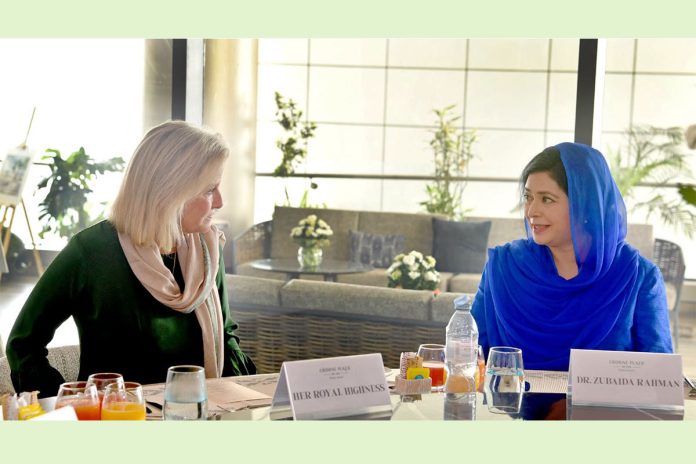
B.Mirror Desk: Prime Minister’s spouse Dr Zubaida Rahman and Britain’s Duchess of Edinburgh on Monday discussed strengthening cooperation on women’s empowerment, maternal and child healthcare, education and the Rohingya crisis, with particular emphasis on protecting vulnerable communities.
The discussions took place during a meeting between Dr Zubaida Rahman and Her Royal Highness the Duchess of Edinburgh in Dhaka, according to a Foreign Ministry press release.
Zubaida Rahman warmly welcomed the Duchess to Bangladesh and appreciated her longstanding commitment to women’s empowerment, girls’ education and the welfare of children and young people.
She also acknowledged the Duchess’s continued engagement in promoting eye health and preventing avoidable blindness.
During the meeting, the two exchanged views on women’s economic empowerment, maternal and child healthcare, combating gender-based violence and expanding opportunities for young people.
Highlighting the government’s commitment to building a healthy Bangladesh, Zubaida Rahman outlined initiatives aimed at reducing maternal mortality and strengthening healthcare services through the recruitment of 100,000 health workers.
She also briefed the Duchess on the government’s social safety net initiatives, including Family Cards and Farmers’ Cards, designed to extend financial and social support to families and communities.
She also underscored the importance of free education for girls and expanding opportunities for women to participate meaningfully in the country’s socioeconomic development.
She also highlighted the longstanding contributions of the Ziaur Rahman Foundation and SUROVI to improving the lives of disadvantaged and marginalised communities.
Elaborating on the foundation’s activities, Zubaida Rahman said its initiatives had focused on placing women at the centre of development by promoting economic independence, self-reliance and skills development.
She explained how the experiences and best practices of these organisations had helped shape the government’s development priorities and were reflected in its election manifesto.
She also highlighted SUROVI’s work in education, child protection, healthcare, nutrition, water, sanitation and hygiene (WASH), and skills development, particularly for children and women from ultra-poor communities.
Referring to initiatives for disadvantaged children and young people, she mentioned the Shishu Swarga Model in urban slum communities, the Blue Sky Programme and the activities of Proyash in supporting children with special needs.


