

S H Fahim: Bangladesh’s debate over bonded warehouse facilities for cotton yarn imports has brought a fundamental question of industrial policy into sharper focus: should the pursuit of cheaper imported inputs come at the expense of the country’s domestic manufacturing capacity?
The issue extends beyond the commercial interests of spinning mills and garment exporters. It concerns the future of industrial employment, domestic value addition, banking-sector investment and the resilience of Bangladesh’s textile supply chain.
The National Board of Revenue’s September 2026 decision to withdraw existing bonded warehouse privileges for imports of 10–30 single-count cotton yarn, while permitting imports against bank guarantees, has prompted disagreement among industry stakeholders. Following subsequent administrative and legal developments, the government has initiated a broader review of the bonded warehouse system.
The challenge is to ensure that short-term procurement advantages do not undermine the long-term foundations of Bangladesh’s industrial economy.
Manufacturing and the Foundations of Economic Strength
The economic development of countries such as Germany, Japan, South Korea and China demonstrates the importance of sustained investment in manufacturing, technological capability and skilled labour.
These economies did not develop industrial strength merely through access to inexpensive imported products. They built production capabilities, supplier networks and technical expertise that enabled them to compete internationally.
Britain offers an instructive historical perspective. Once the world’s leading industrial power, it pioneered large-scale manufacturing across textiles, steel, engineering, shipbuilding and automobiles. Over subsequent decades, many traditional industries contracted as international competition intensified and the economy shifted increasingly towards services.
Britain remains a major advanced economy, and its manufacturing decline should not be equated with economic collapse. Nevertheless, the contraction of traditional industries has left lasting consequences in many industrial communities, particularly through the loss of skilled employment and the weakening of local economic activity.
The broader lesson is that manufacturing capabilities are difficult to rebuild once they disappear. Factories represent more than buildings and machinery. They sustain industrial knowledge, skilled workforces, supplier relationships and technical expertise accumulated over generations.
For a developing economy such as Bangladesh, preserving these capabilities while improving their competitiveness should remain an important economic priority.
Lessons from Zambia’s Industrial Decline
Zambia provides another example of the difficulties associated with a weakening productive base.
The country’s prolonged economic struggles reflected several factors, including dependence on copper exports, declining commodity revenues, debt and structural policy weaknesses.
During the 1990s, trade liberalisation exposed domestic manufacturers to greater international competition. Research published by UNU-WIDER indicates that manufacturing value added declined from approximately 25 per cent of GDP in 1991 to around 10 per cent in 2000.
Manufacturing contraction was not the sole cause of Zambia’s economic difficulties. Nevertheless, its experience illustrates how industrial weakness, limited diversification and external economic pressures can reinforce one another.
For Bangladesh, the relevant lesson is not to avoid international competition, but to recognise the importance of maintaining a diversified and competitive domestic manufacturing base.
Bangladesh’s Jute Industry: A Lesson from Our Own History
Bangladesh’s own industrial history offers an equally important warning.
Jute, once known as the country’s golden fibre, occupied a dominant position in its export economy. During the early years following independence, jute and jute products accounted for the overwhelming majority of export earnings.
Yet the industry gradually lost much of its former prominence.
Competition from synthetic substitutes, changing international demand, inadequate technological modernisation, rising production costs and longstanding structural weaknesses contributed to its decline.
The suspension of production at 25 state-owned jute mills in 2020 represented a particularly significant moment in this process. Although some mills have subsequently resumed operations under private management and private jute manufacturing remains active, the industry no longer enjoys its former economic position.
The decline of jute cannot be attributed to any single policy decision or to import competition alone. Its history nevertheless demonstrates that established industrial capabilities can deteriorate when changing market conditions are not matched by technological adaptation and sound industrial policy.
Bangladesh should consider this experience carefully when assessing the future of its spinning industry.
Once an industrial ecosystem weakens, restoring its productive capacity can require substantial investment, institutional commitment and time.
The Crisis in Domestic Spinning Goes Beyond Mill Owners
Bangladesh has invested heavily in developing an integrated textile industry encompassing spinning, weaving, dyeing and finishing.
This manufacturing infrastructure has supported the growth of the ready-made garment sector and helped retain additional stages of production within the domestic economy.
However, spinning mills are currently operating under considerable financial and operational pressure.
Working capital shortages, high borrowing costs, rising gas prices, unreliable energy supplies, difficulties in financing cotton imports and increasing production expenses have weakened the sector’s competitiveness.
These challenges affect domestic manufacturers even before they compete with imported yarn.
The consequences of a spinning mill’s closure extend well beyond its owners. Workers lose employment, suppliers lose business, banks face increased credit risk and surrounding economic activity contracts.
A spinning mill is therefore not simply an individual manufacturing unit. It forms part of a wider industrial network.
When such capacity is lost, Bangladesh risks becoming more dependent on imported intermediate products, reducing opportunities for domestic value addition and industrial employment.
Rising Yarn Imports and Pressure on Domestic Mills
Recent trade statistics illustrate the scale of Bangladesh’s growing reliance on imported cotton yarn.
According to data published by India’s Ministry of Commerce and Industry, Indian cotton yarn exports to Bangladesh under HS headings 5205, 5206 and 5207 increased from approximately 239 thousand metric tonnes in FY2022–23 to 428 thousand metric tonnes in FY2023–24 and 570 thousand metric tonnes in FY2024–25.
This represents an increase of approximately 138 per cent over two financial years.
Indian-reported exports subsequently eased to approximately 499 thousand metric tonnes in FY2025–26, a partial retreat from the previous year’s peak. Even so, the reported volume remained more than twice the FY2022–23 level. The change should be read alongside Bangladesh’s April 2025 restrictions on yarn imports through land ports, including Benapole. Imports through seaports remained permitted, requiring some importers to use alternative routes that may have increased logistics costs and complexity. These changes may have contributed to the decline, although the available figures do not establish how much of it they explain. The continued flow of Indian yarn through permitted channels shows that import dependence has not disappeared.
The figures highlight the significant role India plays in supplying yarn to Bangladesh’s textile industry.
Meanwhile, domestic textile manufacturers have reported declining yarn sales, reduced capacity utilisation and factory closures. Industry representatives reported in December 2025 that 58 spinning and dyeing mills had partially or fully suspended operations. By June 2026, the Bangladesh Textile Mills Association reported that 234 textile factories had closed since 2019.
These figures relate to different periods and industry categories and should not be combined into a single total.
Nor can rising imports alone explain the difficulties faced by domestic mills. Energy shortages, financing constraints, weak demand and other structural factors have contributed to the industry’s deteriorating operating environment.
Nevertheless, the coexistence of substantial import volumes and growing pressure on domestic manufacturers raises an important economic question: is Bangladesh adequately considering the long-term implications of weakening its spinning capacity?
A comprehensive assessment should examine domestic production, import volumes, capacity utilisation, employment and the financial condition of textile manufacturers.
Without such analysis, decisions based primarily on the immediate price of imported yarn may overlook wider economic consequences.
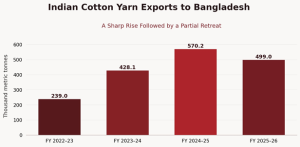
Indian Cotton Yarn Exports to Bangladesh: A Sharp Rise Followed by a Partial Retreat. Indian-reported exports, by Indian financial year (thousand metric tonnes). Source: Indian Ministry of Commerce and Industry; FY2025–26 figure and the underlying series should be checked against the original trade tables before publication.
Indian Yarn Prices: Understanding the Competitive Advantage
India is an important source of competitively priced yarn for Bangladesh’s garment industry.
For export-oriented manufacturers operating under intense international price pressure, the commercial appeal of lower-cost raw materials is understandable.
However, a meaningful comparison should extend beyond the quoted purchase price.
India’s competitive advantage may reflect differences in economies of scale, production efficiency, financing costs, energy availability, logistics, raw material procurement or industrial support policies.
The relative importance of these factors requires objective examination.
Bangladesh’s spinning mills, meanwhile, face substantial disadvantages arising from energy costs, financing constraints and operational uncertainty.
It would be inappropriate to attribute differences in yarn prices to unfair trade practices without credible evidence. Equally, it would be economically shortsighted to disregard the structural disadvantages confronting domestic manufacturers.
The objective should be to establish conditions for fair and sustainable competition while addressing the constraints that prevent local mills from operating efficiently.
Ultimately, a competitive spinning industry must be supported by productivity, quality, technological modernisation and reliable access to energy and finance—not protection alone.
Bonded Warehouse Irregularities: Revenue and Fair Competition at Risk
Bonded warehouse facilities have played an important role in supporting Bangladesh’s export-oriented manufacturing sector by allowing eligible raw materials to be imported without upfront payment of applicable duties and taxes.
However, concerns have periodically emerged regarding potential irregularities in the operation of these facilities.
Where duty-free imported raw materials are diverted into the domestic market rather than used for authorised export production, the consequences can be significant.
The government may lose legitimate revenue, while domestic manufacturers and compliant importers face unfair competition.
Such practices can also undermine confidence in the integrity of the bonded warehouse system.
Stronger customs monitoring, digital inventory tracking, risk-based audits and effective enforcement against established violations are therefore essential.
The objective should not be to weaken legitimate export facilitation, but to ensure that bonded warehouse benefits are used transparently and for their intended purposes.
Ready-Made Garments and Spinning: Partners, Not Competitors
Bangladesh’s ready-made garment industry is the country’s principal export engine. Its competitiveness in international markets is essential for employment, foreign exchange earnings and economic growth.
Garment exporters must have access to competitively priced raw materials, consistent quality and reliable delivery schedules.
At the same time, the domestic spinning industry is an important component of the textile value chain. These sectors should not be regarded as competing interests. Their long-term success is closely connected.
A strong and efficient domestic spinning industry can provide garment manufacturers with shorter lead times, more responsive supply arrangements, reduced exposure to international logistics disruptions and greater opportunities for local value addition.
Domestic spinning mills, in turn, depend on the continued expansion and competitiveness of garment exports.
The objective of industrial policy should therefore be to strengthen the partnership between the two sectors rather than create an artificial choice between them.
Garment exporters should retain access to competitively priced yarn, while efficient domestic mills should have a fair opportunity to compete within a sustainable operating environment.
The competitiveness of Bangladesh’s textile industry ultimately depends on the strength of its entire supply chain.
The Economic Cost of Import Dependence
Imports are an essential part of international trade. Access to competitively priced intermediate goods can improve export performance and support economic growth.
The concern arises when growing dependence on imported inputs is accompanied by a sustained deterioration in domestic productive capacity.
Bangladesh imports cotton because domestic production is insufficient to meet the textile industry’s requirements. However, transforming imported cotton into yarn, fabric and finished garments enables the country to retain additional manufacturing activities and economic value.
If domestic spinning capacity contracts substantially, a greater share of these intermediate production activities may shift overseas.
This could affect employment, banking-sector investments, domestic supply chains and foreign exchange requirements.
The relevant economic question is therefore not whether Bangladesh should import yarn, but whether its industrial policies sufficiently recognise the long-term value of domestic manufacturing capacity.
Short-term procurement savings should not be assessed in isolation from the wider consequences for the national economy.
A Critical Moment for Industrial Policy
The government’s ongoing review of bonded warehouse arrangements for 10–30 single-count cotton yarn provides an opportunity for a comprehensive reassessment.
Prime Minister Tarique Rahman has asked an inter-ministerial committee headed by the Commerce Minister to submit recommendations by 20 November 2026.
The committee’s evaluation should extend beyond the immediate interests of any particular industry group. It should consider domestic production capacity, yarn quality, price competitiveness, employment,
banking-sector exposure, revenue protection, foreign exchange implications and the broader economic benefits of local value addition.
The assessment should also distinguish between yarn counts that domestic mills can supply competitively and specialised products for which local capacity may be insufficient.
At the same time, the government must address the underlying challenges facing spinning mills.
Reliable energy supplies, competitive financing, improved working capital availability, technological modernisation and greater productivity are essential for the industry’s long-term viability.
Trade restrictions alone cannot resolve these structural weaknesses.
A credible industrial strategy must combine fair competition, effective regulation and sustained improvements in the business environment.
Conclusion: Protecting the Capacity to Produce
Bangladesh’s economic transformation has been driven substantially by manufacturing, particularly the development of its textile and garment industries.
The country’s experience with jute, together with lessons from industrial decline elsewhere, demonstrates that established manufacturing capabilities should not be taken for granted.
Once factories close, skilled workers disperse and industrial supply chains weaken, rebuilding productive capacity can become difficult and costly.
This does not mean that domestic industries should be protected indefinitely from competition or that garment exporters should be denied access to affordable raw materials.
It means that industrial policy must look beyond immediate procurement costs and recognise the long-term economic importance of maintaining a competitive domestic manufacturing base.
The future of Bangladesh’s textile industry should not be framed as a choice between imported yarn and domestic spinning.
The real challenge is to create an environment in which garment exporters remain globally competitive while domestic spinning mills have a fair opportunity to become more productive, efficient and financially sustainable.
The question is not simply how cheaply Bangladesh can source yarn today, but how much industrial capability it is prepared to retain for tomorrow.

