


Samata Leather Industries, a listed company on the stock market, has come under scrutiny over alleged inconsistencies in its financial statements, with discrepancies between its quarterly and half-yearly reports raising questions about the accuracy of its reported sales and losses.
An analysis of the company’s financial disclosures for the first half of the 2025-26 fiscal year shows differences between the figures reported for the first and second quarters and those presented in the consolidated six-month statement. The discrepancies indicate that the company reported lower losses and higher sales in its half-yearly financial statements.
According to the quarterly disclosures, Samata Leather incurred a loss of Tk 0.09 per share in the July-September quarter, while it posted earnings of Tk 0.03 per share in the October-December quarter. Based on these figures, its cumulative loss per share for the six months should have stood at Tk 0.06. However, the company reported a loss of only Tk 0.02 per share, understating the loss by Tk 0.04 per share.
Discrepancies were also found in the company’s reported sales. It recorded sales of Tk 47.29 lakh in the first quarter and Tk 4.32 crore in the second quarter, bringing total sales for the six months to Tk 4.79 crore. However, its half-yearly statement showed sales of Tk 4.82 crore, indicating an additional Tk 2.22 lakh in reported revenue.
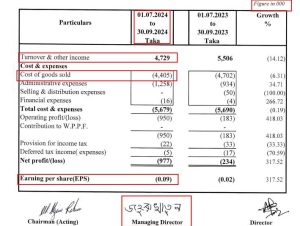
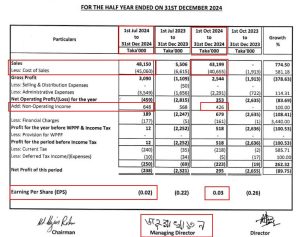
The discrepancy becomes more questionable when compared with the company’s cost of goods sold (COGS). While the half-yearly statement reported higher sales, the cost of goods sold remained unchanged from the combined quarterly figures.
The company reported COGS of Tk 44.05 lakh in the first quarter and Tk 4.07 crore in the second quarter. Their combined amount of Tk 4.51 crore was also reflected in the six-month statement, despite the additional sales revenue of Tk 2.22 lakh.
Further discrepancies were identified in non-operating income. The company reported no non-operating income in the first quarter and Tk 4.26 lakh in the second quarter. Accordingly, the combined six-month figure should have been Tk 4.26 lakh. However, the half-yearly statement showed Tk 6.48 lakh, representing an additional Tk 2.22 lakh.
When contacted about the discrepancies, Company Secretary Mohammad Ramjan Ali reportedly told the news outlet that non-operating income had been included in sales in the first-quarter statement but excluded from sales in the six-month statement. This accounting presentation, he said, accounted for the additional Tk 2.22 lakh in non-operating income.
However, when asked why the six-month sales figure was Tk 2.22 lakh higher rather than lower after the adjustment, he said he would provide a written explanation. No written response was subsequently received.
Meanwhile, the company’s share price has experienced a significant rise despite its weak business fundamentals. Its share price increased from Tk 49.10 on May 19 to Tk 83.40 at the close of trading on November 17, representing a gain of Tk 34.30, or around 70 per cent, in six months. The price had climbed as high as Tk 115.70 on August 25.
The Dhaka Stock Exchange (DSE) has reportedly found no reasonable justification for the abnormal rise in the company’s share price. The exchange has issued several warnings to investors, publishing information to caution them against making investment decisions based on speculative price movements.
The discrepancies in the company’s financial disclosures have further raised concerns about the reliability of its financial reporting and the need for closer regulatory scrutiny.

