

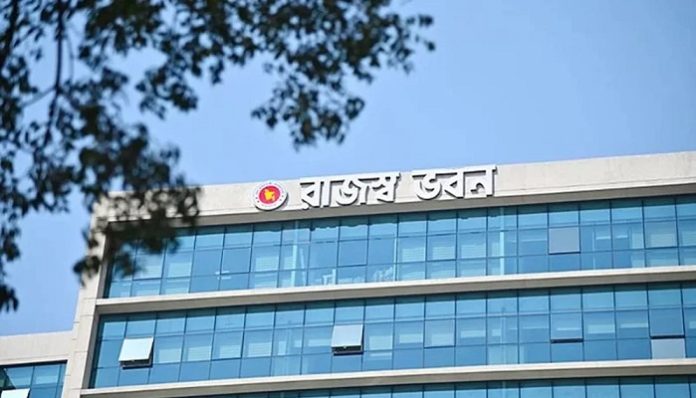
Bangladesh is facing a major revenue shortfall in the first two months of the 2026-27 fiscal year, raising concerns among businesses that intensified tax collection efforts could lead to harassment and coercive practices.
The National Board of Revenue (NBR) collected Tk 55,562 crore against a target of Tk 81,053 crore in July and August, leaving a shortfall of Tk 25,491 crore. Revenue collection also fell significantly short of the target in September, although official figures have not yet been released.
The government has set a revenue collection target of Tk 6.04 lakh crore for the current fiscal year, up from Tk 4.10 lakh crore collected in the previous fiscal year. This requires an additional Tk 1.94 lakh crore in revenue.
The ambitious target comes as the government seeks to finance a Tk 9.38 lakh crore national budget, development projects and planned salary increases for public servants.
To boost collections, the NBR plans to target a major industrial sector for enforcement drives each month. An operation focusing on the pharmaceutical industry was conducted in September, while the sector to be targeted in October has not been disclosed.
The NBR has also instructed officials to verify whether businesses properly use Business Identification Numbers (BINs), strengthen coordination among customs, VAT and income tax departments, increase monitoring at ports and customs stations, and identify businesses operating outside the tax net.
Business leaders, however, have warned that aggressive collection targets without structural reforms could increase pressure on compliant taxpayers.
Anwar-ul Alam Chowdhury Parvez, president of the Bangladesh Chamber of Industries (BCI), said the NBR had been given an ambitious revenue target without the necessary reforms, potentially encouraging coercive collection practices.
Fazlul Hoque, administrator of the Federation of Bangladesh Chambers of Commerce and Industry (FBCCI), said businesses were struggling amid the economic slowdown and urged authorities to focus on tax evaders rather than harassing existing taxpayers.
Former BGMEA director Mohiuddin Rubel stressed that higher earners should pay more taxes and called for an end to irregularities and favouritism in tax collection.
CPD Distinguished Fellow Mustafizur Rahman said revenue growth depended on expanding business, imports, exports and development activities. He also called for automation, institutional reforms and improved efficiency within the NBR, cautioning that pressure alone would not deliver sustainable results.
Meanwhile, the government’s borrowing from the banking sector has increased amid the revenue shortfall. During July-September, it borrowed Tk 23,227 crore from commercial banks and Tk 1,017 crore from Bangladesh Bank.
In the same period of the previous fiscal year, the government had repaid Tk 4,226 crore to commercial banks and Tk 2,699 crore to the central bank. The government plans to borrow a total of Tk 1.12 lakh crore from the banking sector in the current fiscal year.
Economists warn that increased government borrowing could limit credit availability for the private sector, discouraging investment and adding to future debt-servicing costs.
The World Bank has highlighted investment weakness, declining exports, energy shortages and vulnerabilities in the banking sector as risks to Bangladesh’s economic growth. The International Monetary Fund has projected growth of 3.2% in the current fiscal year, alongside inflation of 10.9%, while recommending stronger revenue mobilisation and economic reforms.
Balancing revenue collection, public spending and private-sector investment remains a major challenge for the government.

