

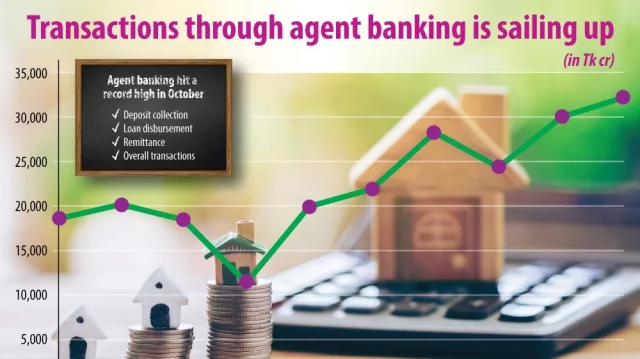
B Mirror Desk : The total disbursement of inward remittances via agent banking increased by 20.87 percent, reaching Tk 1.8 trillion by the end of March 2025.In March 2024, this amount was Tk 1499.16 billion, which rose to Tk 1733.91 billion by December 2024, as reported in the quarterly agent banking report published by the Bangladesh Bank (BB).
A senior official from the central bank noted that during the January to March quarter, the distribution of inward remittances through agent outlets grew by 4.51 percent compared to the previous quarter. He added that the significant volume of remittances processed through agent banking reflects the effective delivery of funds directly to beneficiaries’ doorsteps. This increase in inward remittances through agent banking is believed to be a favorable result of the government’s initiative to offer a 2.5 percent cash incentive on such remittances.
Additionally, the financial literacy campaigns launched by banks, under the theme ‘Enhance Social Awareness to Send Remittance through Legal Channel’ as announced by Bangladesh Bank, are anticipated to positively influence remittance inflows, the official mentioned. He stated that agents are playing a crucial role in this process, as customers can access doorstep banking services in the shortest time possible.
Consequently, agent banking is emerging as a favored method for distributing inward remittances, he continued. The report indicates that agent banking accounts established in rural regions have consistently been the primary recipients of disbursed remittances, accounting for 90.17 percent of the total for March 2025.In contrast, only about 9.83 percent, or Tk 178.03 billion, was received by individuals with agent banking accounts in urban areas.
The top five banks have a 95.46 percent share of the total inward remittances distributed through agent banking till March 2025. Islami Bank Bangladesh PLC ranks the top with Tk 964.27 billion, which is 53.21 percent of the total inward remittances distributed through agent banking.
Dutch-Bangla Bank PLC distributed 26.98 percent while Bank Asia PLC 7.76 percent, Al-Arafah Islami Bank PLC 4.34 percent and Agrani Bank PLC 3.17 percent.
Abdul Quaium Chowdhury, the deputy managing director of Premier Bank PLC, stated that the increasing trend of agent banking, particularly in rural regions, signifies a significant opportunity to integrate the rural unbanked population into formal banking services.He noted that the inflow of remittances into the country is on the rise, as the government has implemented measures to enhance the legal framework, encouraging non-resident Bangladeshis (NRBs) to remit funds back home.
Agent banking was introduced in Bangladesh-by-Bangladesh Bank in 2013 to offer a secure alternative delivery channel for banking services. This service primarily targets the underserved communities residing in remote areas that are typically inaccessible to traditional banking networks. Through agent banking outlets, customers can access a variety of banking services, such as deposits, loans, local and international remittances, payment services (including utility bills and taxes), and the disbursement of government social safety-net benefits.
This model is increasingly favored as a cost-effective and convenient means of delivering banking services to a large segment of the population that would otherwise be excluded from conventional banking.Banks conduct their agent banking operations in accordance with the Prudential Guidelines for Agent Banking Operation in Bangladesh, which were issued by Bangladesh Bank on September 18, 2017. These guidelines address various elements, including the agent approval process, allowable activities, and the responsibilities of both banks and agents.
Additionally, the guidelines emphasize the importance of anti-money laundering and combating the financing of terrorism (AML/CFT), as well as customer protection and business continuity, to ensure the safe and effective expansion of agent banking throughout the country.

