

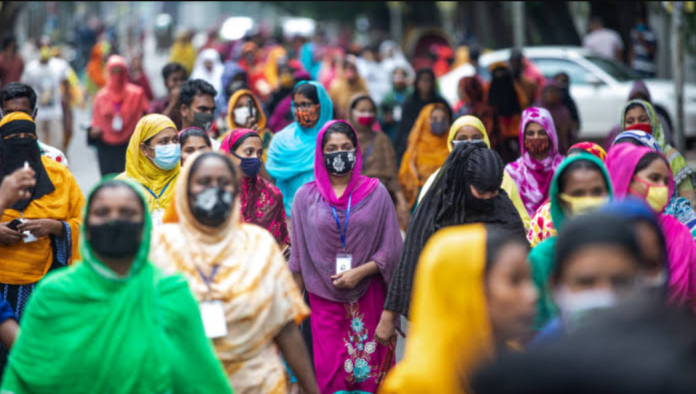
Factory closures, order shortages and retrenchment are pushing thousands of experienced workers into uncertain livelihoods; men turn to street vending and battery-powered rickshaws, while women face even fewer options
Kazi Azizul Islam: For 13 years, Sohag Mia worked in three different garment factories, building his livelihood around a sector that had long provided him with a steady income. In his last job at a factory in Ashulia, he earned around Tk 18,000 a month.
Then, in June, the job disappeared.
The factory was struggling with a shortage of orders and financial difficulties, and Sohag was among those who lost their employment. With three other members of his family—including a daughter and a son—to support, he could not afford to remain without an income for long.
He immediately began searching for another job in the garment sector.
But this time, finding another factory job was not easy.
After failing to secure employment, Sohag turned to street vending. He initially began selling fruits and later switched to selling vegetables, trying to make ends meet in a business far removed from the factory floor where he had spent more than a decade working.
“Days are very uncertain now, as this is a business of perishables; some days I make a profit and many days I have to count losses,” Sohag told this correspondent.
His experience is increasingly becoming a reality for workers who lose their jobs in garment and textile factories but cannot quickly find alternative employment.
According to Sohag, Dhaka and its surrounding suburbs now have tens of thousands of fruit and vegetable street vendors. A significant portion of them, he said, are former garment and textile workers who were pushed into informal businesses after losing their factory jobs.
For these workers, the transition from factory employment to street vending is not simply a change of occupation. It means moving from a regular monthly wage to an uncertain daily income, with no guarantee that a day’s work will produce a day’s earnings.
Women face an even harder struggle
The employment crisis is even more difficult for female garment workers, who often have fewer opportunities to enter alternative forms of work.
Shymoli Akter had already spent 12 years working in the garment sector. At the time she lost her job nearly a year ago, she was earning Tk 15,535 a month. Despite continuing efforts to find employment, she has still been unable to secure another job.
For Shymoli, becoming a street vendor is not an easy option.
“You know, in Bangladeshi society, it is difficult for us females to start and operate a street business; moreover, capital is a big question,” Shymoli told this correspondent.
Her experience underscores the unequal consequences of job loss for men and women. While some male workers can move into street businesses, drive battery-powered rickshaws or pursue other informal work, women often face social and financial barriers that make such alternatives difficult.
The result is that losing a factory job can leave female workers unemployed for much longer.
When losing one job no longer means finding another
Khadiza Akter, a worker organizer, said thousands of workers have lost their jobs over the past couple of years. But what makes the present situation particularly alarming, she said, is that workers who lose employment are no longer finding jobs in other factories as quickly as they traditionally did.
That change has fundamentally altered the employment landscape for garment workers.
In the past, a worker who lost a job could often move to another factory and continue earning. Now, according to Khadiza, that route is becoming increasingly uncertain.
The observation is echoed by Syed Sultan Uddin Ahmed, Executive Director of the Bangladesh Institute of Labour Studies (BILS).
Ahmed said factory closures have increased to an all-time high over the past couple of years, leaving workers jobless for indefinite periods.
“Male workers are trying to find livelihoods by driving battery-powered rickshaws or doing street business, while some of those having organizing experience are joining the labor wings of political parties,” Sultan said, citing a random survey on jobless workers.
The pattern is markedly different for women.
As female workers cannot easily enter street businesses, many have recently been searching for work as domestic workers, Sultan said.
Apart from a few exceptions, most female workers who lose their jobs are returning to their villages, while male workers generally prefer to remain in cities and look for alternative livelihoods, he added.
Factory closures deepen employment crisis
The individual stories of Sohag and Shymoli are unfolding against a wider employment crisis in Bangladesh’s garment sector.
Industry insiders said at least 500 garment factories have shut down over the past two and a half years, putting the livelihoods of thousands of workers under increasing pressure.
Reports citing data from the Industrial Police, the Bangladesh Garment Manufacturers and Exporters Association (BGMEA) and the Bangladesh Knitwear Manufacturers and Exporters Association (BKMEA) said at least 20,000 workers were affected by layoffs and retrenchment in the first six months of the current year.
The situation has been particularly severe in Gazipur.
According to the Industrial Police, a total of 158 garment factories in the district shut down between May 3, 2025, and April 11, 2026.
Garment workers’ leader Nazma Akter estimates that total job losses in the garment sector over the past two and a half years could be at least 200,000.
Behind each of these figures is a worker facing the same fundamental question: what comes next?
For workers like Sohag, the answer has been street vending. For others, it means driving battery-powered rickshaws or taking whatever informal work is available. For many female workers, the choices are even narrower, with some seeking domestic work and others returning to their villages.
The loss of a garment job, therefore, increasingly appears to be more than a temporary interruption in employment. It can mean a prolonged struggle to rebuild a livelihood.
The growing employment crisis in the garment sector is also a matter of concern for the broader economy.
Towfiqul Islam Khan, a senior economist at the Centre for Policy Dialogue, said the export-oriented garment industry is the country’s largest formal economic sector in terms of industrial employment. He described the recent job losses as “really worrisome” for the economy.
“The government and the industry’s local and international stakeholder should concertedly work to prevent decay in the industry as for decades RMG industry here has been an engine of empowerment of women and low income group youths,” he said.
A sector vital to the economy
The garment sector remains one of the most important pillars of Bangladesh’s economy. According to the figures cited in the draft, it contributes nearly one-tenth of the country’s total gross domestic product.
Bangladesh is the world’s second-largest ready-made garment exporter and generates roughly $39 billion annually from the sector, accounting for around 80 percent of the country’s total export earnings.
A 2022 industry survey cited in the draft found that the garment industry provided employment to more than four million workers.
That makes the current employment trend particularly significant.
When a factory closes, the consequences do not end at its gates. A worker loses a monthly salary. A family loses financial security. Household spending becomes uncertain. And a skilled worker with years of experience may suddenly find himself or herself competing for low-paid informal work.
For Sohag, years of factory experience have now been replaced by the uncertainty of selling fruits and vegetables on the street.
For Shymoli, 12 years in the garment industry have not yet translated into another job.
Their stories put a human face on the statistics surrounding factory closures, layoffs and retrenchment.
And as factory closures continue and new employment becomes harder to secure, the question facing Bangladesh’s garment sector is no longer simply how many factories have closed or how many workers have lost their jobs.
The bigger question is how these experienced workers—and the families that depend on them—will survive when the factory jobs that once sustained them disappear.

