

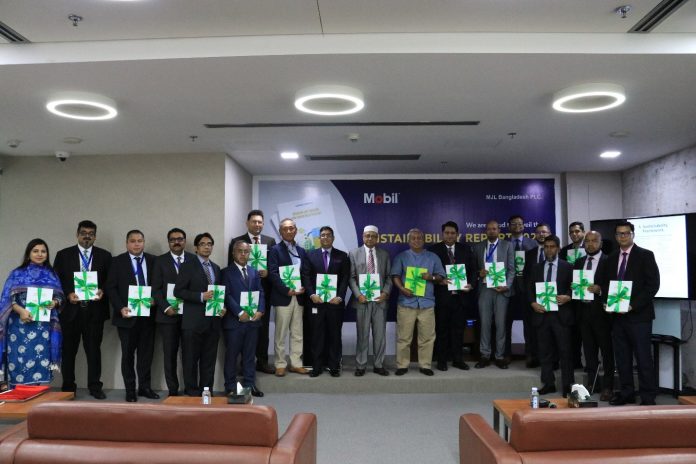
By Engr. Md Shahin Alom, Senior General Manager and Sustainable Lead coordinator, MJL Bangladesh PLC.
In the age of climate urgency, where sustainability has moved from the boardroom periphery to the very heart of corporate strategy, MJL Bangladesh PLC. has emerged as one of the most compelling examples of how an energy sector leader can align profitability with purpose. The publication of its Sustainability Report 2024 marks not just another annual disclosure, but a comprehensive declaration of its intent to transform Bangladesh’s downstream energy sector into a greener, safer, and more inclusive industry.
This column examines the company’s sustainability commitments, its alignment with the United Nations Sustainable Development Goals (UN SDGs), milestones in environmental and social governance, detailed progress on emission reduction and net-zero targets, and the broader message of responsible leadership.
Sustainability as Core Business DNA: At the heart of MJL’s operations lies a conviction: true business success extends beyond financial performance. The company’s Managing Director, Azam J. Chowdhury, makes this clear in his opening statement: success must be measured not only in profit margins but also in how responsibly a company protects the planet and empowers people.
This is not rhetoric. Sustainability has been woven into MJL’s corporate DNA—visible in its world-class Lube Oil Blending Plant (LOBP) in Chattogram, the LEED Platinum-certified Mobil House headquarters in Dhaka, and bold social initiatives that stretch from community healthcare to skill development programs across Bangladesh.
The message from CEO Md. Mukul Hossain echoes this dual commitment: ensuring energy security for the nation while minimizing environmental harm. “Every drop of lubricant we produce, every safety protocol we implement, and every customer we serve carries the promise: to keep Bangladesh’s industries running smoothly while protecting the people and the planet,” he writes.
Adding to this, Director Tanjil Chowdhury of MJL Bangladesh PLC. emphasizes that sustainability is no longer optional, but a strategic imperative for the petroleum downstream and all sectors. “We must adopt sustainability practices today to protect our environment for future generations. As a petroleum downstream company, it is our duty to ensure that energy solutions come with responsibility, resilience, and respect for nature,” he notes.
Governance and Assurance: Transparency at the Core: MJL’s 2024 report was prepared under a multi-stakeholder review panel, with oversight ranging from the Managing Director and CEO to heads of audit, supply chain, engineering, and HR. The process involved: Verification of 78 ESG metrics, independent assurance by internal auditors, Stakeholder surveys involving more strengthening, benchmarking against GRI, IFRS S1/S2, and TNFD frameworks.
This rigorous governance ensures that the sustainability claims are not greenwashing but backed by auditable data and measurable progress. The company’s repeated wins at the ICSB National Awards for Corporate Governance Excellence underscore its commitment to ethical leadership and regulatory compliance, as well as the Circle of Excellence Award from ExxonMobil.
In fact, MJL Bangladesh PLC. has been recognized in the Bloomberg ESG rating, standing out among the country’s top corporates for highest governance standards. This global recognition is no small feat. It affirms that MJL’s governance structure is not just compliant but exemplary—ranking it among the leading corporates in Bangladesh for corporate governance excellence.
Performance of Mobil lubricants meets Sustainability: A critical element of MJL’s sustainability narrative lies in its high-performance Mobil lubricants, manufactured under ExxonMobil’s stringent Product Integrity Management System.
- Synthetic lubricants are engineered with advanced molecular structures that provide extended Oil Drain Intervals (ODI). This reduces the frequency of oil changes, minimizing waste oil generation, packaging waste, and transport emissions.
- Extended ODI translates into fewer production cycles, cutting the equivalent greenhouse gas (GHG) emissions associated with manufacturing and logistics.
- High-purity synthetic base oils deliver improved oxidation stability, lower evaporation, and cleaner engine operation—directly contributing to lower CO₂ emissions per kilometer driven.
- By enhancing engine efficiency and protecting against wear, these lubricants extend equipment life and reduce resource consumption.
This fusion of performance and sustainability ensures that MJL’s products are not only powering Bangladesh’s industries but also protecting the environment in line with SDGs 7, 12, and 13.
Alignment with the UN’s 17 Sustainable Development Goals: MJL Bangladesh PLC. positions itself as a proud contributor to the UN SDGs. In practice, this means more than aspirational statements—it translates into measurable impacts few of which are:
- SDG 7 (Affordable & Clean Energy): 465,982 kWh generated from solar power in 2024, with plans to increase renewable energy to 30% by 2030.
- SDG 11 (Sustainable Cities & Communities): The LEED Platinum Mobil House consumes 30% less energy and 50% less water than conventional buildings.
- SDG 13 (Climate Action): Net-zero 2050 commitment, a phased decarbonization roadmap, and 9% reduction in CO₂ emissions year-on-year.
- SDG 4 (Quality Education): More than 3,200 car mechanics trained, 2,240 individuals in industrial engineering programs, and direct collaboration with BUET, RUET, and MIST on sustainable lubrication research.
- SDG 5 (Gender Equality): Female participation stands at 5%, with a target of 8% by 2030 and dedicated leadership development initiatives.
- SDG 3 (Good Health & Well-Being): Zero workplace fatalities since 2021 and financial support for employee and community healthcare programs, including the Bakhtunnessa Chowdhury Diabetes Center serving over 5,000 patients.
MJL’s approach is holistic: all 17 SDGs are addressed, from poverty alleviation through Zakat programs to biodiversity conservation via tree-planting and mangrove restoration.
Emissions: Measuring the Footprint: The 2024 emissions baseline provides clarity on the company’s environmental footprint: Total emissions: 1,109.59 tCO₂e (down 9% from 2023). Per employee emissions: 6.16 tCO₂e (14% reduction).
- Breakdown by scope:
- Scope 1 (diesel combustion): 80.56 tCO₂e (7.3%).
- Scope 2 (purchased electricity): 1,024.75 tCO₂e (92.4%).
- Scope 3 (water supply): 4.28 tCO₂e (0.4%).
The clear message: electricity use is the biggest challenge, not on-site fuel. Thus, renewable energy adoption is rightly placed at the center of the strategy.
MJL has already installed solar capacity at Dhaka, Chattogram, and the LOBP canteen, generating enough clean electricity to offset around 170 tCO₂e annually. Future targets include 500+ kW solar by 2035 and green hydrogen pilots in the medium term.
Net-Zero 2050 Roadmap: The company’s roadmap aligns with the Paris Agreement and Bangladesh’s Nationally Determined Contributions (NDCs). It is structured into three phases:
Phase 1 (2024–2030): “Efficiency & Transition”: 30% reduction in Scope 1 & 2 emissions, Additional 150 kW solar capacity, Shift to LPG/NG and pilot electric forklifts, Full Scope 3 audit.
Phase 2 (2031–2040): “Decarbonization & Innovation”: 60% emissions reduction, 100% renewable electricity via solar, wind, and PPAs, Green hydrogen boilers, Circular economy practices like zero-waste packaging.
Phase 3 (2041–2050): “Net-Zero Achievement”: Complete phase-out of diesel vehicles, align with global standard, Net-Zero certification via Science-Based Targets initiative (SBTi).
This phased approach demonstrates both ambition and realism—tackling the low-hanging fruits first, then moving to disruptive technologies and offsets.
Social Commitment, Communities at the Core: Sustainability for MJL does not stop at emissions. The report documents over 15,000 beneficiaries across education, healthcare, skill development, and welfare in 2024 alone. Highlights include:
Education: Scholarships for employee children, computer donations, and technical partnerships with universities.
Healthcare: Support to Ma & Shishu Hospital, eye camps for 550 transport workers, and long-term funding for diabetes treatment centers.
Skill Development:
- 200 professional drivers trained.
- 55 women enrolled in the Women Driver Awareness Program.
- 5,000 lubricant end-users trained in efficient practices.
Social Welfare: BDT millions contribution to Welfare Fund for social development.
These initiatives strengthen MJL’s role as not just an industrial powerhouse, but a community development partner.
Governance: A Model for Corporate Bangladesh: In an era when governance scandals often dominate headlines, MJL has charted a different path—one of accountability, and transparent reporting.
Key governance features include: Board oversight with gender diversity (14% female representation). Compliance with OECD corporate governance principles and BSEC regulations. Independent audits for ESG metrics. Active memberships in the Dhaka and Chattogram Stock Exchanges, Bangladesh Association of Publicly Listed Companies, and the Asian Lubricants Industry Association (ALIA).
Repeated recognition—such as the ICMAB Best Corporate Award and the ExxonMobil Marketing Excellence Award 2023—validates MJL’s standing as a benchmark for governance excellence.
A Milestone Year: The 2024 Sustainability Report is itself a milestone: the first time MJL Bangladesh PLC. has applied the GRI 4 framework, with plans for external assurance by 2030.
Concrete achievements from this year include:
- 9% reduction in CO₂ emissions year-on-year.
- 97% reduction in packaging material use via bulk lubricant distribution.
- Zero fatalities and 70% reduction in injuries since 2021.
- 93% employee retention rate.
- Expansion of retail and industrial touchpoints to 35,000+ nationwide.
These numbers demonstrate progress not just in intent but in delivery.
Looking Ahead: MJL’s journey is far from over. The road to Net-Zero 2050 will demand deeper decarbonization, larger investments in renewables, stronger supplier engagement, and continued governance discipline. Challenges such as high grid emission factors and the cost of green hydrogen remain. Yet the company has already outlined risk mitigation strategies—from accelerating off-grid renewables to seeking global climate finance.
The report makes clear that MJL does not see sustainability as a compliance checkbox, but as a competitive advantage. By reducing emissions intensity to 21% below the industry average, it is already proving that sustainability can be a driver of both efficiency and market leadership.
A Blueprint for Corporate Bangladesh: The MJL Bangladesh PLC. Sustainability Report 2024 is more than a corporate disclosure—it is a blueprint for responsible growth in an economy where industrial expansion often collides with environmental constraints.
By aligning with the UN SDGs, adopting global ESG frameworks, and setting ambitious yet achievable net-zero targets, MJL is demonstrating that Bangladeshi companies can lead in sustainability rather than lag.
It is a story of ambition, accountability, and action. And if replicated across industries, it could well be the foundation of a low-carbon, inclusive, and prosperous Bangladesh by 2050.

