

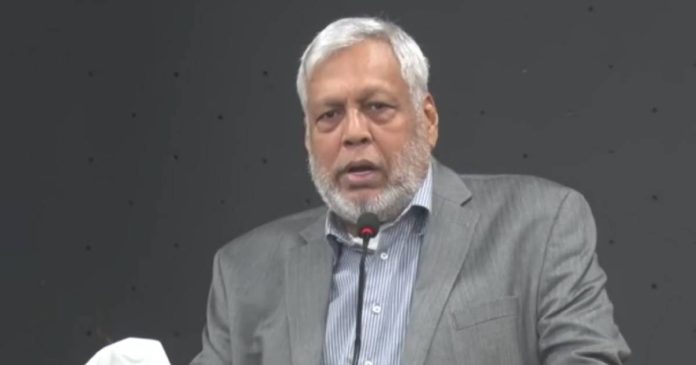
Controlling LPG prices is essential to addressing the nation’s immediate energy problem, according to Mohammad Fauzul Kabir Khan, Advisor to the Interim Government in charge of the Ministry of Power, Energy, and Mineral Resources. Because a cylinder now costs more than Tk 1,200 on the market, neither industrial nor residential customers are benefiting enough. But he insisted that the cost should not exceed Tk 1,000.
He made these remarks as the chief guest at a policy conclave titled “LPG in Bangladesh: Economy, Environment, and Safety”, organized by the daily Bonik Barta, held on Saturday (October 11) at the Grand Ballroom of the Pan Pacific Sonargaon Hotel in Dhaka.
The adviser said that the key challenge for LPG is its price. While the listed price of a cylinder is around Tk 1,200, in some cases, it is being sold for Tk 1,400–1,500. Therefore, controlling prices, improving logistics, and increasing private sector efficiency are extremely important. Without responsible business practices, ensuring the country’s energy security is not possible.
He further stated that the primary energy shortage in the country is not a natural crisis but a result of planned circumstances—created by certain politicians in power and their allied business groups. The demand for gas supply has been overlooked in planning for power generation and gas pipelines, resulting in a large number of illegal connections in industries and households.
Fauzul Kabir Khan noted that domestic gas production is declining every year. Around 200 million cubic feet of gas production is being lost annually, while only 70 million cubic feet of new gas has been sourced. As a result, LNG is being imported, although it has drawn criticism due to its high cost.
He mentioned that LNG import requires a long-term process, so in the short term, LPG could serve as an effective alternative to bridge the energy gap.
The event also featured Dr. Abdul Moyeen Khan, a member of BNP’s National Standing Committee, as a special guest, and Jalal Ahmed, Chairman of the Bangladesh Energy Regulatory Commission (BERC), as an honored guest.


