

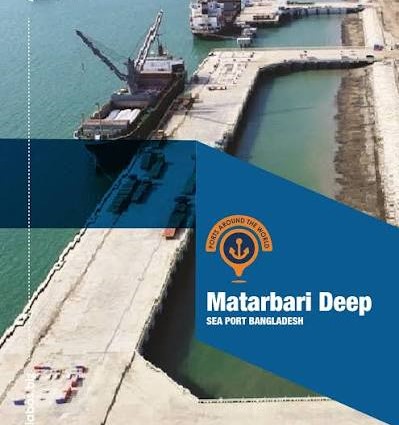
Japan is planning to develop a regional industrial value chain centred on the Matarbari deep-sea port in Bangladesh, aiming to strengthen connectivity and trade among Bangladesh, India’s northeastern states and Southeast Asia.
According to a report by India’s The Hindu, citing diplomatic sources in Tokyo, Japan wants to connect India’s seven northeastern states with the Bay of Bengal and Southeast Asian markets through Bangladesh.
The initiative is expected to feature prominently during Prime Minister Tarique Rahman’s proposed visit to Japan, scheduled to begin on October 26. Dhaka may seek Japanese financial assistance for industrial, port and commercial infrastructure projects around Matarbari between 2026 and 2031.
A senior Japanese diplomatic source told The Hindu that the Matarbari deep-sea port could enhance Bangladesh’s economic potential and help transform the country into a regional industrial hub. The port is also expected to play a significant role in expanding connectivity and trade with neighbouring countries.
Once completed, Matarbari will be Bangladesh’s only deep-sea port. Currently, the country relies on ports in Singapore, Colombo in Sri Lanka and Malaysia to handle cargo transported by large vessels. The new port is expected to enable Bangladesh to participate more directly in international shipping and trade.
Japan’s vision extends beyond port development. Tokyo is considering a broader industrial and commercial connectivity network linking Bangladesh with India’s northeastern states and potentially Bhutan, Nepal and Myanmar. Such a network could create new opportunities for regional trade, cargo transportation and industrial production.
Japan has previous experience in developing regional economic corridors. The diplomatic source cited the development corridor connecting Bangkok in Thailand with Cambodia and Vietnam as a model for promoting regional economic growth through port infrastructure and transport links.
Japanese officials believe a similar approach could help Bangladesh emerge as a regional connectivity hub, provided cross-border infrastructure and trade cooperation are strengthened.
The Matarbari deep-sea port project is being implemented with financing from the Japan International Cooperation Agency (JICA). A significant portion of the project’s initial work and progress took place during the previous Awami League government, when relations between Bangladesh and India were comparatively cordial, creating opportunities to advance cross-border connectivity initiatives.
During that period, the Maitree Setu, or Friendship Bridge, was built over the Feni River to connect Bangladesh with India’s Tripura state. The bridge could facilitate access between India’s northeastern region and the ports of Chattogram and Matarbari. However, political uncertainty and strained bilateral relations have reportedly prevented the bridge from being used to its full potential.
Despite these challenges, Japanese officials remain optimistic about the long-term prospects for Bangladesh-India cooperation. They believe improved connectivity through Bangladesh could enhance Matarbari’s operational efficiency and economic significance.
According to reports published on October 17, the Maheshkhali-Matarbari Integrated Infrastructure Development Initiative (MMIDII) is expected to be a key topic during Tarique Rahman’s visit to Japan.
Bangladesh may propose a strategic investment and cooperation package worth 2.2 trillion yen, or approximately $14 billion, to Japan. Of this amount, Dhaka reportedly plans to seek 500 billion yen, equivalent to around $3.14 billion, for developing the MMIDII and the Matarbari hub.
The proposed financing could support the development of deep-sea port and logistics facilities, road and rail connectivity, industrial infrastructure and economic zones.
If implemented, the plans could transform Matarbari from a major centre for Bangladesh’s imports and exports into a strategic gateway linking South Asia with Southeast Asia, supporting regional industrialisation, trade and economic integration.

