

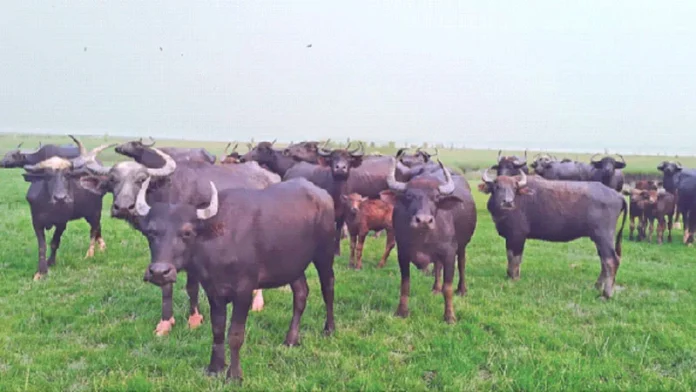
Azad, Lakshmipur Correspondent: Seven islands (chars) remain separated from the mainland of Raipur and Ramgati upazilas of Lakshmipur. Four of these chars have developed distinct identities between the two upazilas. On the vast grass-covered lands of these islands, numerous buffalo herding sites (bathans) have emerged. From these chars alone, about 5,320 tons of milk are produced annually. The famous buffalo yogurt of Ramgati and Raipur is produced here—around 4,410 tons per year. The combined annual market value of milk and yogurt exceeds Tk 700 crore. Additionally, buffalo sales and the livelihoods of 500 people involved in rearing add further economic significance.
Most residents cultivate rice on char lands for their livelihood. Some also rear cows and buffaloes. This is the situation in Char Gojaria and Maulvir Char of Ramgati, and Char Kachhia, Tunu Char, and Jalia Char of Raipur. But the scenes in Lombakhali, Char Abdullah, Notun Char of Ramgati, and Char Kachhia and Tunu Char of Raipur are quite different. Here, buffalo rearing has developed into a profitable sector. Across these five chars, there are nearly 10,000 buffaloes and sheep, alongside several hundred cows and goats. Every day, these chars produce 10 to 15 tons of buffalo milk, which is used to produce the traditional buffalo yogurt of Ramgati and Raipur. Through buffalo rearing, the livelihood and economy of these chars have gained a strong foundation.
Lombakhali and Char Abdullah fall under Char Abdullah Union, Notun Char under Barokheri Union, and Tunu Char and Kachhia Char under North and South Charbhanshi unions of Raipur. It takes 30–40 minutes by trawler to reach Char Abdullah from Ramgati sadar; Notun Char is about half an hour away. From the town, it takes 50–60 minutes to reach the chars of Raipur. The economy of the entire upazila largely depends on these remote chars.
According to the livestock offices of Raipur and Ramgati: The milk produced in the 5 chars of Raipur and the 3 chars of Ramgati fetches around Tk 300 crore annually.Yogurt sales amount to around Tk 400 crore per year.Generally, milk sells for Tk 80 per liter and yogurt for Tk 250 per liter.
Data from the livestock and veterinary offices show that Raipur and Ramgati have 8,390 buffaloes, including 6,843 milking buffaloes. Of these, over 6,000 buffaloes are found in just six chars. About 90% of buffalo rearing takes place in chars, and the rest in local villages. Nearly 500 people earn their livelihoods from buffalo rearing in these chars—some rear their own buffaloes, while others rear buffaloes owned by others on a share basis. There are herdsmen and laborers as well. Raipur has 132 buffalo farmers and Ramgati has 157; among them, 78 are doing relatively well and all rear buffaloes in the chars.
Local residents say that only 15–20% of the buffaloes belong to their actual owners; the rest are reared under a sharecropping system. Md. Selim and Md. Didar, residents of Char Alexander Union and owners of several hundred buffaloes, said they entrust their buffaloes to share-rearers. They mainly buy buffaloes and send them to the chars. The rearers graze and raise the buffaloes, milk them, and sell the milk. The profit from the milk is shared between the owner and rearer. When a buffalo is sold, profits are shared equally after deducting the purchase cost. Many owners in these chars follow this model. Large farmers earn Tk 22–23 lakh annually.
Nur Nabi Mir, owner of a bathan in Char Abdullah, said he has been raising buffaloes there for 25 years. He started with just five buffaloes. Now he owns 125 buffaloes and over 800 sheep, with eight workers employed at his farm. In Notun Char of Barokheri alone, there are more than 2,500 buffaloes, and across the three chars of Ramgati, there are over 4,500 buffaloes.
Another bathan owner, Md. Lokman, said, “I currently have 432 buffaloes in Char Abdullah. Since winter has just begun, milk production is lower now—5 to 6 maunds on average per day. My farm has also created employment for locals. I buy and sell buffaloes several times a year.”
Sobhan, a farmer from Tunu Char, said, “I have over 100 buffaloes. I sell milk every day. Recently, I sold a pair of buffalo calves for Tk 30,000. Adult buffaloes sell for Tk 100,000–200,000 depending on size.”
Bathan owner Malek Majhi said, “A buffalo produces about five liters of milk a day. If there is a shortage of grass, milk production drops. If half of the char land can be reserved for crops and the rest for grazing, there is no problem.”
Makhan Lal and Dilip Pal, yogurt traders from Raipur market, said they have sourced buffalo milk from these chars for many years. Mandal Kuri, a milk seller at Haydarganj market, said, “Every day, several maunds of buffalo milk come from the remote chars to my shop. I give advance payments to the farmers to ensure a steady supply. This milk is then supplied to yogurt sellers in various markets. After meeting local demand, milk is sent to nearby upazilas.”
District Livestock Officer Dr. AKM Fazlul Haque said Raipur, Sadar, Kamalnagar, and Ramgati chars play a vital role in meeting the demand for buffalo milk and meat. The traditional buffalo yogurt of this region is made from this milk. “There have even been reports of disputes at weddings and events when buffalo yogurt was not served,” he added. Around 20 tons of buffalo milk are produced daily. Last month alone, 500 tons were produced, and around 6,000 tons are produced annually. Every year, about 3,070 tons of buffalo yogurt are also made in this region.


 remain separated from the mainland of Raipur and Ramgati upazilas of Lakshmipur.)