

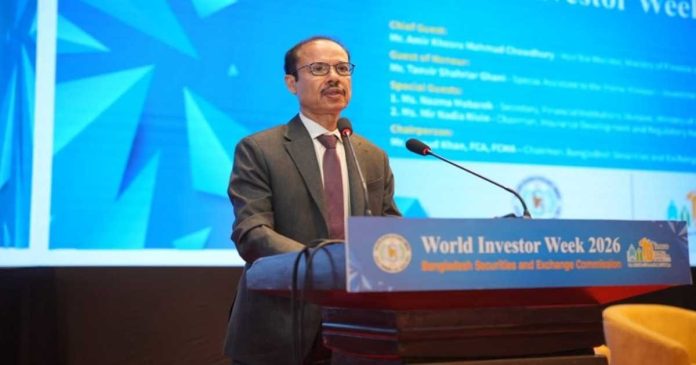
B Mirror Report: Bangladesh’s capital market is poised for a revival in initial public offerings (IPOs), with several domestic and foreign companies preparing to enter the market, Bangladesh Securities and Exchange Commission (BSEC) Chairman Masud Khan has said.
He said two to three foreign companies could announce their entry into the country’s capital market within the next few months, expressing optimism about a gradual recovery in IPO activity.
Speaking at the inauguration of World Investor Week 2026 at the Krishibid Institution Bangladesh auditorium in Dhaka on Sunday, Khan said lengthy IPO approval procedures had previously discouraged companies from listing on the stock market.
He noted that the approval process used to take between one and one-and-a-half years. The current commission has simplified the process and aims to complete IPO approvals within three months.
The BSEC chairman also outlined plans to expand direct listing opportunities for selected companies, strengthen the role of the Dhaka Stock Exchange (DSE) and Chittagong Stock Exchange (CSE) in listing procedures, and introduce artificial intelligence (AI) into market surveillance systems.
He said increasing the number of listed companies would help expand market capitalisation and potentially boost trading activity. Referring to comparisons with Pakistan, he noted that Bangladesh’s daily turnover of around Tk 700 crore was considerably lower than Pakistan’s approximately Tk 6,000 crore, partly because of the difference in market size.
Khan said the commission had introduced stricter eligibility criteria for direct listings to ensure that only established and financially stronger companies could access the facility. The revised framework also provides opportunities for multinational and large domestic firms to enter the market through internationally recognised valuation methods.
A hybrid listing system has also been introduced, allowing companies to raise fresh capital from the public while enabling existing shareholders to sell part of their holdings.
Highlighting recent market developments, Khan said the removal of the floor price was among the commission’s major initial decisions. He argued that the floor price had reduced the attractiveness of Bangladesh’s stock market to foreign investors.
He added that market activity had gained momentum, with turnover exceeding Tk 70,000 crore in September. Foreign investors’ purchases also surpassed their sales during the month, raising hopes of renewed foreign participation.
The BSEC chairman stressed that restoring investor confidence and preventing past irregularities were among the commission’s top priorities. To strengthen oversight, the regulator plans to integrate brokerage back-office software into a unified, real-time system that would allow the DSE to monitor brokers’ bank balances and take immediate action when necessary.
AI-based surveillance will also be introduced at both the DSE and BSEC, while trading and order management systems will be further digitised. The commission aims to automate transaction confirmations and eliminate the need for physical signatures to reduce opportunities for fraud.
Khan also said a proposal to harmonise existing securities laws and ordinances had been sent to the Ministry of Law for final approval. The proposed changes are expected to facilitate direct filing of cases with the securities tribunal and accelerate the resolution of market-related disputes.
On the bond market, he said the commission had approved bonds worth around Tk 3,500 crore since the new commission took office. Bond issuers have been required to list on the main board to ensure investors have an exit opportunity through the stock market.
He also highlighted the approval of a Tk 180 crore Orange Bond aimed at women’s empowerment, alongside initiatives involving green bonds and other debt instruments. The commission is also exploring ways to encourage insurance companies, mutual funds and provident funds to increase their investments in corporate bonds and equities.
Khan said preparations were underway to introduce derivatives trading, alongside reforms to clearing and settlement arrangements. He added that several long-pending regulatory reforms, including changes to dividend, borrowing and rights-share regulations, were also in progress.
He reaffirmed that the commission’s broader objective was to restore investor confidence, improve transparency and modernise the capital market through faster IPO approvals, digital surveillance, stronger institutional participation and expanded investment opportunities.


, with several domestic and foreign companies preparing)