

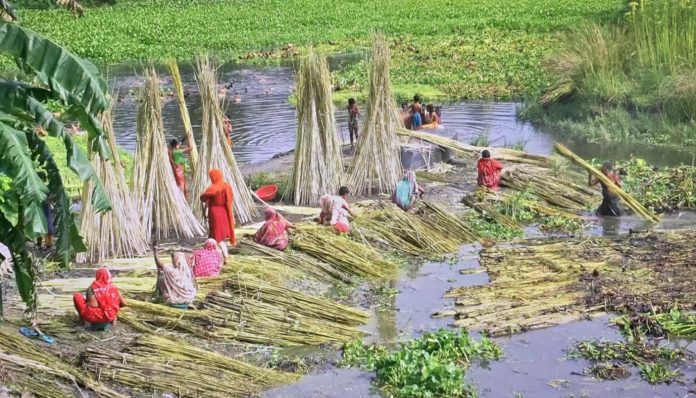
Niaz Brahmanbaria Correspondent : This season, there has been a bumper jute harvest in the haor regions of Brahmanbaria. In rural areas, farmers are currently engaged in harvesting, retting, and drying the jute. However, due to a lack of sufficient and timely water for retting at the beginning of the season, many farmers in the lowland areas have faced difficulties.
Farmers complain that even though production costs have increased, they are not receiving fair prices for their jute. As a result, many are losing interest in jute cultivation. However, the district administration has stated that a fixed market price for jute will be determined this year.
Historically, jute was once known as the “golden fiber” due to its high demand and export value, but those golden days are long gone. Still, many jute farmers in Brahmanbaria continue cultivating it as part of their family tradition.
Although high temperatures and unfavorable weather conditions this year have resulted in slightly smaller jute plants, overall yields have been good. In remote villages, the harvesting, retting, and drying of jute are in full swing. However, due to a lack of sufficient water during the monsoon, many farmers are struggling to properly ret and process the jute, which has increased both labor and production costs. Without receiving fair market prices, many farmers have expressed frustration.
Md. Jasim, a jute farmer from Nasirnagar, said,
“We’re facing major financial challenges cultivating jute. Fertilizer prices are high, and cultivation costs have increased. After all the expenses, the sale price doesn’t cover our costs. Middlemen are making profits by stocking and selling at higher prices, but we don’t get fair rates. This year, we’re selling at Tk. 3,200 per maund. If the government fixed a minimum price, we could sell at that rate.”
Another farmer, Safor Mia from Nabinagar, said,
“After all the hard work and expenses, we barely recover our investment. Last year’s low prices discouraged many from cultivating jute this year. On top of that, this season’s biggest issue is the lack of water in canals for retting, forcing us to travel far. Labor and transport costs have increased, but prices haven’t. If the government set a fixed price, we farmers would benefit—we might even have some savings.”
According to Dr. Mostafa Emran Hossain, Deputy Director of the Department of Agricultural Extension in Brahmanbaria,
“This season, jute has been cultivated on 4,455 hectares of land across the haor areas of Sadar, Nasirnagar, Sarail, Bijoynagar, Nabinagar, and Bancharampur. Our target was 4,453 hectares, so we’ve slightly exceeded expectations. Kenaf jute, in particular, has yielded well this year.”
Brahmanbaria District Commissioner Mohammad Didarul Alam said,
“The Nasirnagar area is very suitable for jute cultivation. However, due to insufficient water, farmers are facing difficulties with retting. If the water levels rise, it will help them. The administration is closely monitoring the market to ensure farmers get fair prices. We’re in discussions to set a market price soon and will inform the farmers once it’s finalized.”
According to the Agriculture Department, it is estimated that at least Tk. 60 crore worth of jute will be sold in the Brahmanbaria region this season.

