

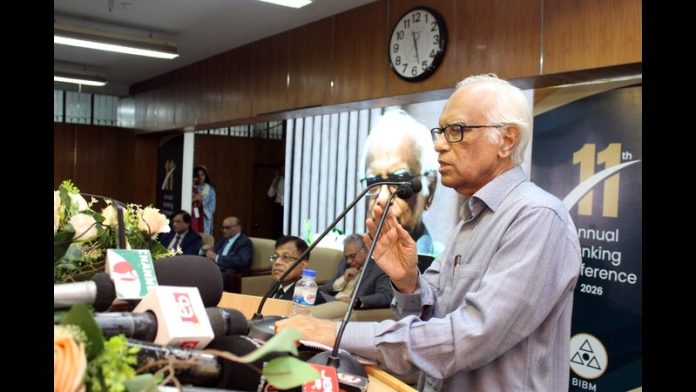
Former interim government adviser for planning and education Wahiduddin Mahmud has said that the culture of bank looting is far more damaging than the culture of loan defaults, warning that unchecked irregularities have pushed Bangladesh’s financial sector into a deep crisis.
Speaking at the opening session of a two-day annual banking conference organised by the Bangladesh Institute of Bank Management (BIBM) in Mirpur, Dhaka, on Wednesday, he said a culture of bank looting had emerged after 2010, despite earlier efforts to restore discipline through banking reforms and regulations.
Mahmud said extensive efforts had once been made to tackle loan defaults by introducing rules and regulatory safeguards, helping bring some private banks closer to international standards. However, the subsequent wave of bank looting had undermined those gains, with money taken from banks without adequate compliance with regulations.
He cited the collapse of some banks established with teachers’ salaries, benefits, welfare funds and pension contributions, saying billions of taka belonging to poor and government-approved non-government schoolteachers remained stuck in the failed institutions.
Emphasising the need to learn from past experience, Mahmud said Bangladesh had previously allowed private banks to be established without an adequate regulatory framework. As a result, sponsor-directors at the time had reportedly borrowed an amount equivalent to around 35 per cent of their banks’ total deposits.
He also called for restrictions on any single business group or family controlling multiple banks, arguing that such safeguards should fall under antitrust legislation. Bangladesh still lacks an effective antitrust or anti-monopoly law, he said.
Mahmud further warned against allowing influential political figures to use state-owned banks as vehicles for distributing favours. If governments seek to provide politically motivated benefits, they should choose areas that do not cause substantial damage to the economy, he added.
According to Mahmud, the approval of numerous new banks without proper scrutiny after 2010 contributed to the failure of some institutions, several of which had also received deposits from government entities.
He attributed the current banking crisis partly to the excessive relaxation of regulations over the past 15 years. While some rules may need to be eased to rescue weak banks, he questioned how the authorities could guarantee that similar policy mistakes would not be repeated.
To restore stability, Mahmud said banks should be given an opportunity to recover and stand on their own, but only with adequate safeguards. Each case must be assessed individually to ensure that funds reach honest entrepreneurs and genuine businesses, he said, warning that failure to do so could push the sector back into the same cycle of mismanagement.
Other speakers at the conference included Bangladesh Bank Deputy Governor Md. Kabir Ahmed; Bangladesh Association of Banks President and Dhaka Bank Chairman Abdul Hai Sarker; World Bank Division Director for Bangladesh and Bhutan Jean Pesme; and Association of Bankers, Bangladesh Chairman and City Bank Managing Director and CEO Masrur Arefin.
Zaidi Sattar, chairman of the Policy Research Institute, presented the keynote paper.

