

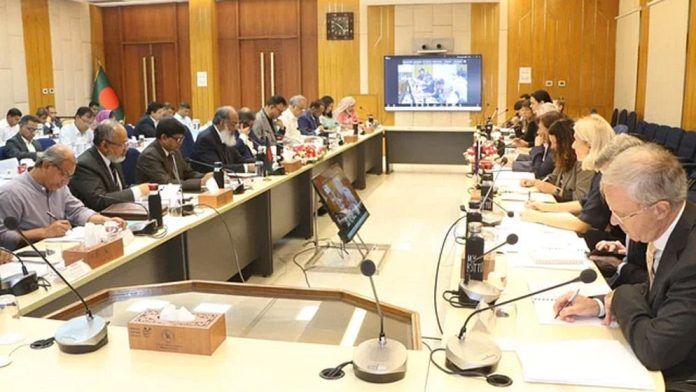
Bangladesh has sought revision of the GSP benefits policy regarding the legality and trade of illegal Bangladeshi migrants in Europe.
This matter came up in the joint commission meeting of Bangladesh and the European Union (EU). In the meeting, even after the LDC transition, Bangladesh gets GSP benefits in the European market. At the same time, the issue of sending the Rohingyas from Myanmar back to their own country through multilateral initiatives is also of special importance in the discussion.
The 11th meeting of the Bangladesh-EU Joint Commission was held on Monday (November 4) at the NEC meeting room in the capital’s Sherebangla Nagar. Shahriar Quader Siddiqui, Secretary of the Department of Economic Relations of the Ministry of Finance and Paula Pampaloni, Deputy Managing Director of the EU’s Asia and Pacific Division, led the meeting.
According to the sources of the meeting, the EU wants to hire more skilled workers under the Talent Partnership Program. European countries are interested in taking manpower from Bangladesh in about 10 sectors. The government is preparing a roadmap to legally send skilled manpower to those EU countries. If all goes well, the roadmap will be released with mutual consent.
Currently, Germany, Italy, Greece and Romania are interested in taking manpower from Bangladesh. The priority sectors identified in the joint commission meeting are ICT, caregiving, construction, tourism and hospitality, agriculture and agro-processing, shipbuilding and ready-made garments.
The EU announced the Talent Partnership Program in April 2022. Through this, seven countries including Bangladesh have been taken into consideration outside the EU countries, from which the EU countries want to take skilled workers. As such, the opportunity to send Bangladeshis to Europe legally will increase.
Bangladesh-EU discuss in detail the progress of Talent Partnership. On the one hand, Europe wants more skilled workers legally, on the other hand, many Bangladeshis are living in Europe illegally. Bangladesh has also recommended their legalization.
Sources of the meeting also said that Bangladesh raised some demands to the EU representatives regarding the revision of the GSP policy. One of these is to consider revising the EU’s new (draft) GSP scheme, particularly the safeguard clauses. As if all products of Bangladesh, including readymade garments (RMG) products can get GSP plus benefits.
Besides, some GSP policies have been requested to be amended so that Bangladeshi products can enter the European market duty-free. The new EU GSP regime and its safeguard provisions have been called for suspension. It was also discussed that the EU market should not penalize Bangladesh’s garment sector due to LDC transition.
Sources in the meeting said that EU is the biggest buyer of Bangladeshi products including ready-made garments. As a least developed (LDC) country, Bangladesh does not have to pay any duty on exports of goods under the EBA (all goods except arms) category under the GSP facility to the European market. Even if Bangladesh is promoted to developing country in 2024, this benefit will continue till 2027.
If the GSP benefits are lost, instead of zero percent, Bangladesh will have to export goods to European Union countries with 12 percent duty overnight. These issues were discussed in the Bangladesh-EU joint commission meeting.
In the meeting, Bangladesh recommended to extend the period of GSP facility. However, the EU representative said that the issue of extending the GSP benefits will be discussed after looking at the compliance of the factory or improved working environment and various issues of the workers.
According to the sources of the meeting, the EU has given an additional three-year transition period. As a result, Bangladesh will have access to the same facilities till the end of November 2029. After the three-year transition period ends in 2029, discussions have been held on how Bangladesh can extend the facility further.
Alternatively, Bangladesh can apply for the GSP scheme, which will have duty-free access to 66 percent of EU tariff lines, including textiles and clothing. In this case, Bangladesh must fulfill two criteria. One of which is vulnerability criteria and the other is sustainable development criteria. In this regard, Bangladesh-EU joint statement said that the crisis faced by Bangladesh after the corona epidemic was discussed.
The ongoing Russia-Ukraine crisis, the impact of the Israeli attack on Gaza on Bangladesh were also discussed. Bangladesh claims that facing these adverse effects has an impact on inflation and inflation in the country.
Meanwhile, the World Economic Outlook for July 2024 has been released by the International Monetary Fund. It has been reported that the global economic growth will be 3.2 percent in 2024 and 3.3 percent in 2025. As a result, the global economic recession has affected Bangladesh and slowed down the development here (Bangladesh) like other countries in the world, Bangladesh said.
The joint statement also informed that the growth rate of Bangladesh’s gross domestic product (GDP) in the fiscal year 2021-22 is 7.1 percent. 5.78 percent in FY 2022-23 and 5.82 percent is estimated for the current fiscal year. These issues were discussed in the joint commission meeting. The recent picture of global loans, grants and debt repayments in Bangladesh was also discussed in the joint commission meeting.
The EU says the country’s financial sector has challenges that need to be addressed through sound policies and interventions. Areas requiring major intervention include governance, management and recovery of financial and credit conditions, capital market management, inflation control, consumption expenditure control and employment. A more far-reaching plan is also needed for poverty alleviation. There is a need for extensive reforms in the country’s financial sector. Bangladesh has to take loans and credits on concessional terms.
Both Bangladesh and the European Union have pledged to ensure accountability for crimes committed against the Rohingya in Myanmar through various multilateral initiatives.
The people of Bangladesh, the government, as well as the international humanitarian community, including NGOs, are jointly addressing the humanitarian challenges posed by the Rohingya crisis in Bangladesh. The EU expresses its appreciation for the humanitarian role and actions of governments and people.
At the meeting, both the European Union and Bangladesh agreed to strengthen economic ties by increasing trade and investment flows. It was decided that the two sides would trade on the principle of Everything But Arms (EBA).
The EU is currently Bangladesh’s main trading partner, and both sides are committed to further enhancing the EU-Bangladesh climate dialogue, the joint statement said. Any future commercial relationship is conditional on respect for human rights, including labor rights.
The Government of Bangladesh will adhere to International Labor Organization (ILO) Conventions based on quality sustainable reforms of labor rights and tripartite relations. The EU and Bangladesh have agreed to develop a roadmap on several issues to strengthen compliance with labor and human rights.

